By Justine Chahal, Solving Sacramento
“Sacramento Noir” is an upcoming anthology featuring 13 short stories penned by mostly local authors as part of the Akashic Books Noir Series, which publishes collections of noir short stories focused on different cities. Each story in the local volume is set in a different location, including Midtown in Sacramento and the Southport neighborhood in West Sacramento.
John Freeman, a Sacramento native and the book’s editor, says he proposed the book idea because he thought the city was fitting for the noir genre as an atmospheric location with a history that feels both present and very subtle.
 John Freeman is the editor of “Sacramento Noir.” Freeman is the executive editor at Alfred A Knopf and a writer.Photo courtesy of John Freeman
“I feel like Sacramento is a much older and diverse city than people appreciate, and the contributors who were working on the stories chose neighborhoods where they could write directly into issues that face people in Sacramento — whether it's housing or schooling,” Freeman says, adding that the authors also add their own “kind of spin of history and how neighborhoods hold and are changed by the passage of time.”
Events following the book’s release on March 4 will be held in local bookstores Time Tested Books, Avid Reader, Capital Books and Beers Books.
CapLit will also host its debut event on Friday, March 7 at the CLARA Auditorium where actors will read excerpts from four featured stories in “Sacramento Noir,” according to writer Shelley Blanton-Stroud. Naomi Williams — who also wrote a story for the collection — co-founded CapLit, a literary organization that puts on productions based on literary works.
Blanton-Stroud, who has previously had her stories read at CLARA, says it’s delightful to hear another person read their stories because their tone of voice and gestures allow her to discover something new about their work.
Freeman says he wanted the contributors to have freedom in what they wrote, which led to the inclusion of different neighborhoods and even time periods. However, Freeman says the book really focuses on the people who make up the city, creating a window into what it feels like to live in Sacramento through noir.
“There’s all of these private revelations that happen in our lives, and to me, one of the great qualities of literature is to give you a kind of story for that to happen and for you to be tricked into believing that it's happening to you; that someone else's private Sacramento is yours,” Freeman says.
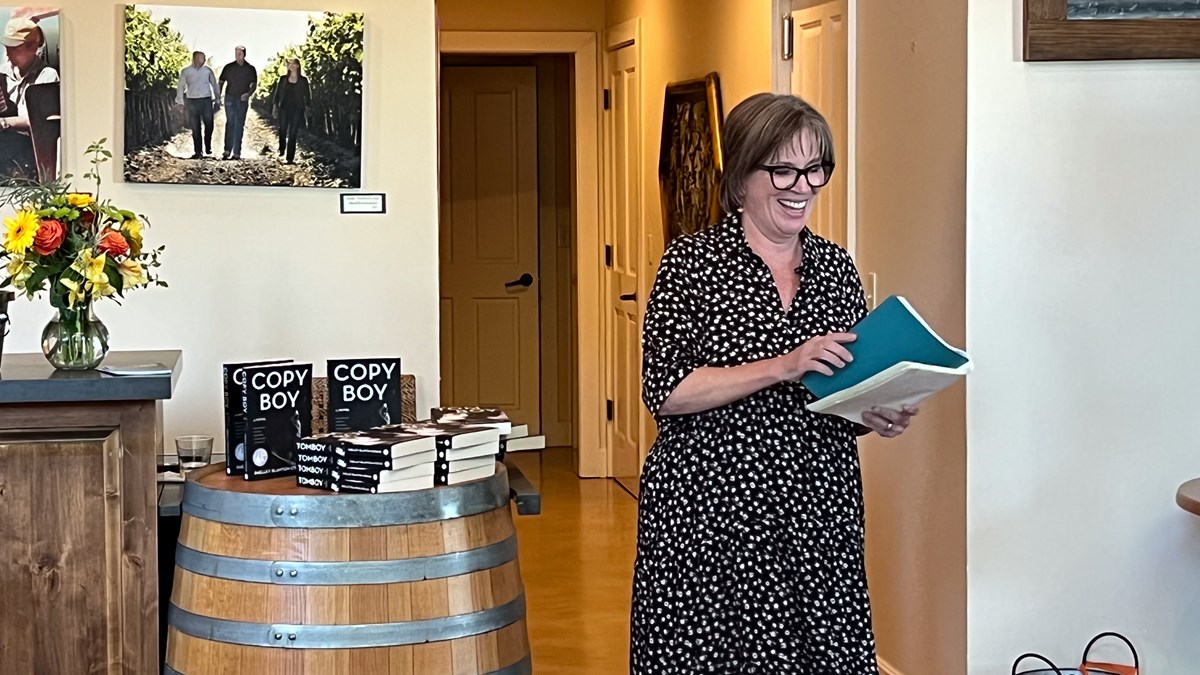 Shelley Blanton-Stroud, one of the writers featured in “Sacramento Noir,” at the launch party for her book “Tomboy,” hosted by Bogle Winery in Clarksburg.Courtesy of Shelley Blanton-Stroud
Blanton-Stroud’s story took inspiration from her own neighborhood of Sierra Oaks and the rumors surrounding the previous owners of her home, who were reportedly related to the bystander who was crushed when the marquee of the Hippodrome theater — now called Crest Theatre — crashed to the ground in 1946. Her story also addresses rumors around the now torn-down Tudor house that used to exist a block away from her, she says.
When she looked into these stories, Blanton-Stroud says she was interested in separating facts from rumors and exploring the history of her Sierra Oaks neighborhood.
“I would think about its position in this beautiful, well-tended neighborhood and the obvious problems behind the gate, but also the question marks about those problems,” Blanton-Stroud says. “I was really interested in looking at my own neighborhood in a noir kind of way. What receives the full light of [the] sun and what is in darkness in my own neighborhood?”
Blanton-Stroud’s story is the first of the collection, underneath the section “Family Business.” Freeman says he grouped stories with similar themes into sections after reading them. The second section, “Collisions,” refers to when people’s worlds collide, whereas the last section titled “Tale of Two Cities,” explores how people from different backgrounds juxtapose Sacramento against their place of origin, he says.
This juxtaposition is seen in Nora Rodriguez Camagna’s story, which depicts the dangers faced by a Latino farmworking family living in South Sacramento through a child’s perspective.
She says she wanted to examine the unexpected dangers present after immigrating, especially for undocumented immigrants who cannot report crimes. She also wanted to focus on the lives of families who are rarely featured in mainstream media.
“We have our own, very deep interior lives that sometimes don't have anything to do with the rest of what everyone else is thinking we're worried about,” Camagna says. “They're more concerned about is there enough food? The refrigerator ran out, how am I going to avoid this relative? Just very interior lives that I think we all don't see a lot in writing.”
Camagna says she is excited to attend the upcoming events alongside her fellow contributors and hopes the literary world of Sacramento will become more connected through this collection.
Freeman says making this book felt meaningful because Sacramento and its stories made him into the writer he is today.
“Sacramento has given me everything,” Freeman says. “It's given me a childhood, images, friendships, all the influences that made my imagination. I'm so happy to put these stories together because I think the writers who wrote them did exceptional jobs at what they wanted to do.”
Those interested in meeting the writers and picking up a copy of “Sacramento Noir” can do so at the following events:
Time Tested Books
Thursday, March 6 at 7 p.m.
Featured writers: Naomi J. Williams, Maureen O’Leary, Jamil Jan Kochai and Janet Rodriguez
CLARA Auditorium
Friday, March 7 at 7 p.m.
Featured writers: John Freeman, Maceo Montoya, Nora Rodriguez Camagna and Shelley Blanton-Stroud
Avid Reader (Davis)
Monday, March 10 at 6 p.m.
Featured writers: Reyna Grande, Jen Soong, Luis Avalos and José Vadi
Capital Books
Saturday, April 5 at 2 p.m.
Featured writers: Nora Camagna, Janet Rodriguez and José Vadi
Beers Books
Saturday, May 3 at 6 p.m.
Featured writers: Janet Rodriguez, Naomi Williams, Maureen O’Leary and Luis Avalos
Editor's note: An earlier version of this story included an incorrect location and featured writers list for the March 10 event. It has since been corrected.
This story is part of the Solving Sacramento journalism collaborative. This story was funded by the City of Sacramento's Arts and Creative Economy Journalism Grant to Solving Sacramento. Following our journalism code of ethics, the city had no editorial influence over this story. Our partners include California Groundbreakers, Capital Public Radio, Outword, Russian America Media, Sacramento Business Journal, Sacramento News & Review, Sacramento Observer and Univision 19. Sign up for our “Sac Art Pulse” newsletter here.
Follow us for more stories like this
CapRadio provides a trusted source of news because of you. As a nonprofit organization, donations from people like you sustain the journalism that allows us to discover stories that are important to our audience. If you believe in what we do and support our mission, please donate today.
Donate Today