At the top of Sacramento International Airport’s six-story parking garage, the air smells faintly of fuel and asphalt. Heat ripples off the tarmac. A United Airlines 737 noses onto the runway and begins its takeoff roll. The low growl of engines becomes a roar as it lifts into the sky.
Marissa Forte raises her camera, tracks the motion through her viewfinder and clicks the shutter just before the aircraft’s wheels retract into the fuselage.
Forte is a plane spotter.
“Every shot you get is unique,” she says. “It's just all about that uniqueness and appreciating the engineering marvel that planes are.”
Forte, a recent Sacramento State graduate with a degree in political science, has been plane spotting for five years. It’s a hobby that blends her love of photography, a passion for aviation and her desire for precision.
“I just like the feeling of airplanes,” she says. “I like the feeling of flying, like that free spirit character archetype.”
As unusual as it may seem to spend hours in a parking garage photographing airplanes, Forte doesn’t see it as much different from other hobbies.
“Plane spotting is essentially birdwatching, but they’re metal,” she says. “You need to go specifically where they’re at. Like certain birds are not here in California; it’s the same thing with airplanes. You won’t see a 787 landing in Sacramento. You’re going to have to drive to San Francisco to see that kind of thing.”
Sacramento is fertile ground for the hobby. The county operates four public airports: Sacramento International, Executive, Franklin Field and Mather. Commercial flights bring in Boeing 737s and Airbus A320s from Southwest and United. Hawaiian Airlines occasionally lands a widebody Airbus A330. Amazon 767s come and go with cargo. Cal Fire’s tankers are based at nearby McClellan Airport, where spotters might see a C-130, or a vintage fighter, depending on the day.
“In one area within 30 minutes you can see one of the largest cargo aircraft in the world from Amazon,” says Stephen Clark, deputy director of commercial development at the Sacramento County Department of Airports. “Then 30 minutes later you could be seeing a World War II aircraft out at Mather doing touch and goes.”
Clark is more than an administrator. He’s a spotter, too.
He grew up near an Air Force base and began spotting as a child. Now, with years in the aviation industry, he still tracks flights on his phone, knows the schedules and watches aircraft through his office window.
“A mile of runway can take you so far compared to what a mile of road can do,” he says. “When you watch an airplane take off at the end of the runway, it can still take your breath away unlike any other mode of transportation.”
That fascination is part of the draw for many spotters. Using tools like FlightRadar24, they know what’s coming, where it’s coming from and when it will land.
Spotting isn’t just about staring at the sky and hoping; it’s research, timing and commitment.
One of the more challenging locations to spot at Sacramento International Airport is a patchy stretch of Elkhorn Boulevard that dead-ends into a barbed-wire security fence just 700 feet from a runway—35 left, in aviation parlance. The road is flanked by nut orchards on one side and dozens of humming beehives on the other. It’s hot, exposed and unnerving for anyone uncomfortable around bees. But for dedicated spotters, it’s worth it.
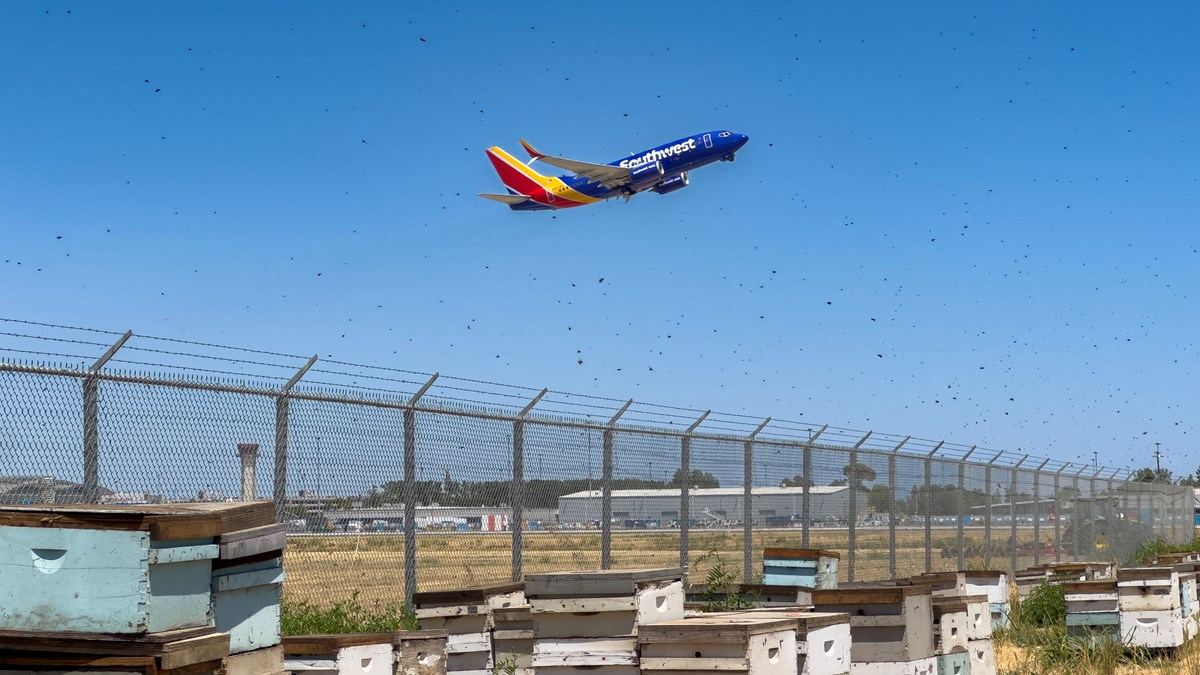 A Southwest Airlines jet takes off from Sacramento International Airport on July 18, 2025. The area is a favorite of plane spotters despite the proximity to dozens of beehives.Greg Micek/CapRadio
Forte prefers the top of the parking garage, especially when she’s looking for a specific aircraft. It gives her a view of both terminals, which increases her odds of catching something rare. On days when a special livery or unusual jet is scheduled to land, she might stay for hours.
“Sometimes it’s targeted, sometimes I just kind of chill,” she says.
Jon Schade, a former flight dispatcher and current airport operations officer, has spotted at Sacramento and says the airport's layout is a big plus.
“You’ve got a runway on each side,” he says. “You can watch planes land from the West Coast, you can watch planes from the East Coast.”
Schade picked up the hobby years ago while living near Dallas. He convinced his sister to lend him a video camera and started filming aircraft at Dallas Fort Worth International Airport.
“It was kind of like exploring everything,” he says. “Kind of like an animal who just gets out of a cage and there’s this whole world around them.”
Since then, he’s started an aviation YouTube channel and sees spotting as stress relief.
“It’s just so cathartic and relaxing,” he says. “Because you’re focused on what’s coming in, what’s taking off. It’s just mesmerizing.”
Schade says part of the appeal is that anyone can join in.
“You’ll see people of all ages do it,” he says. “Kids will do it, and people in their 60s. I’ve met people in their 80s doing it as well. You don’t need a $20,000 camera. You can use an iPhone.”
Plane spotters come in a variety of forms. Some are content to just watch. Others collect models, run aviation-themed YouTube channels or post photos to JetPhotos, a platform where enthusiasts share their best shots.
Forte, who describes herself as a “Boeing girly,” not only takes photos but also collects scale models of select aircraft.
“I only collect plane models of planes that I’ve seen because it limits how many I can get,” she says. “So I don’t spend hundreds of thousands, even though my collection probably already adds up to that.”
While spotters are often approached by police or airport security—especially when cameras and fences are involved—Schade says the pastime is harmless.
“The number one thing we always get is security or police asking, ‘What are you doing?’” he says. “We’re just watching the planes and watching them land and take off. That’s it.”
Clark says safety is always the top priority and asks that spotters keep their activities to public areas. But he also sees value in allowing people to stay connected to aviation, even from a distance.
Sacramento’s airports lack the dedicated spotting areas of other major airports. In San Francisco, spotters can use designated locations, but only after requesting a permit online. At LAX, an unofficial viewing area next to an In-N-Out Burger draws spotters from around the country. In Sacramento, spotting is more ad hoc. Most work alone or with a friend, spread across the parking garage, fence lines and rural roads. A community linked more by shared interest than by formal groups or gatherings.
Still, Clark does not rule out the idea of creating a space to encourage spotting in the future.
“We always take a look at opportunities to bring the community closer to us,” he says.
Back on the top of the parking garage, Forte laments the lack of remaining storage on her camera’s SD card as an American Airlines 737 MAX 8 begins to taxi. She checks its destination on her phone, adjusts her camera strap and lifts the lens.
She steadies her hands with the focus of a wildlife photographer and waits for liftoff.
Follow us for more stories like this
CapRadio provides a trusted source of news because of you. As a nonprofit organization, donations from people like you sustain the journalism that allows us to discover stories that are important to our audience. If you believe in what we do and support our mission, please donate today.
Donate Today