The rise (and fall?) of Tyler Perry
Tyler Perry, the capitalist vs. Tyler Perry, the artist
Update RequiredTo play audio, update browser or
Flash plugin.
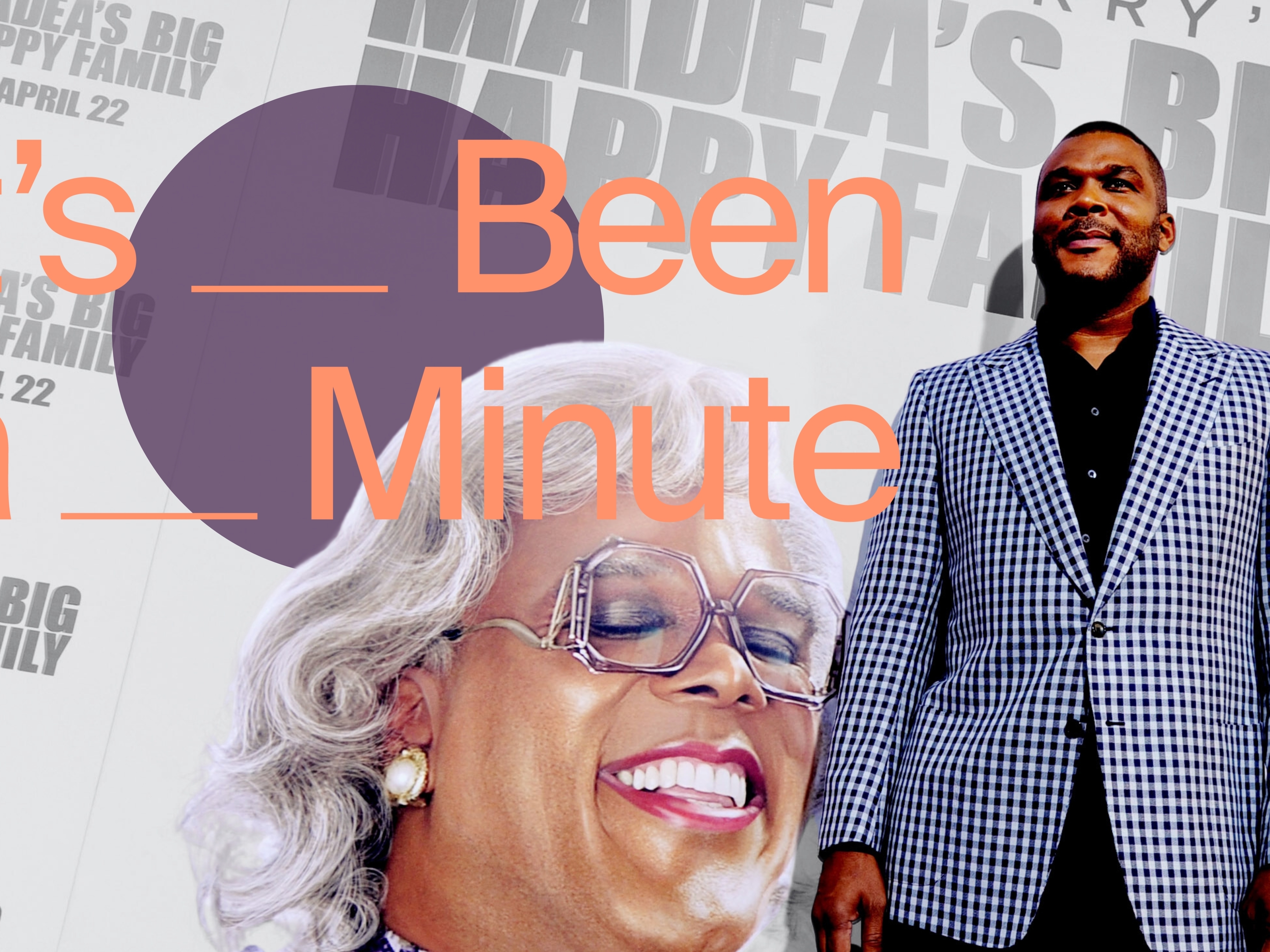
Tyler Perry's media empire spans television, film, and theater.
Kevin Winter/Getty Images
Tyler Perry is many things, but is he someone we should aspire to be?
Entertainment mogul Tyler Perry has built a media empire that has spanned theater, film, and television. And he’s recently been accused by an employee of sexual harassment.
Brittany is joined by entertainment journalist and author Tre'vell Anderson and SUNY Purchase theater and performance professor William Bryant Miles to dive head-first into the Madea-verse, asking how Tyler Perry became such a media powerhouse, and whether these allegations of wrongdoing threaten to topple the fraught media empire he has built.
Transcript
BRITTANY LUSE, HOST:
Hello, hello. I'm Brittany Luse, and you're listening to IT'S BEEN A MINUTE from NPR, a show about what's going on in culture and why it doesn't happen by accident.
(SOUNDBITE OF MUSIC)
LUSE: OK, everybody. We need to talk about a media mogul who has found himself in a lot of, we'll say, mess lately.
(SOUNDBITE OF MUSIC)
LUSE: His name is Tyler Perry. But some of you may know him better as...
(SOUNDBITE OF FILM, "MADEA GOES TO JAIL")
TYLER PERRY: (As Madea) Ma to the damn D-E-A, OK?
LUSE: Madea, aka Tyler Perry's gun-toting, sailor-mouthed drag persona who has garnered millions of fans over the past two decades, becoming something of an icon. And from the movies...
(SOUNDBITE OF ARCHIVED RECORDING)
PERRY: (As Madea) It's hot as hell in this Cadillac, honey. I don't have no air conditioner.
LUSE: ...To the plays...
(SOUNDBITE OF ARCHIVED RECORDING)
PERRY: (As Madea) I'm trying to leave that pole alone. I can't drop it like it's hot no more.
LUSE: ...Tyler Perry has built a media empire that has spanned theater, film and television.
(SOUNDBITE OF MUSIC)
WILLIAM BRYANT MILES: Sometimes the work pops up on Amazon. Sometimes it pops up on Netflix. It's just happening everywhere.
LUSE: That's William Bryant Miles, professor of theater and performance at SUNY Purchase College.
MILES: And you don't see that often.
(SOUNDBITE OF MUSIC)
TRE'VELL ANDERSON: Tyler Perry built his core audience off of the plays.
LUSE: That's entertainment journalist and author Tre'vell Anderson.
ANDERSON: And then there is a shift that happens in his career where you can see that he is interested in more money, more access, more control. And that looks like him taking on different roles outside of the Madea world. That looks like him, at one point, retiring Madea so that he could focus on non-Madea projects. And then just a few short years later, when you get a Netflix deal, now we got more Madea.
LUSE: But for all his success, Tyler Perry is facing some backlash. So today, I'm going to try to understand just how Tyler Perry's ascension to Hollywood A-list status happened, how his business model might impact your TV even if you don't watch his shows or movies, and whether or not some recent allegations of wrongdoing will tear a hole in the outsized media empire he's built.
(SOUNDBITE OF ARCHIVED RECORDING)
PERRY: (As Madea) Was Jesus a Black man? We figure, uh-uh. Can't be, 'cause he always on time.
(LAUGHTER)
PERRY: (As Madea) He always on time.
(SOUNDBITE OF MUSIC)
LUSE: Today, we're entering the Madea-verse.
(SOUNDBITE OF MUSIC)
LUSE: There have been critiques of Tyler Perry's work from the very beginning. I mean, dating back to his earliest Madea plays, there were some, you know, critics, some people who painted his work as an example of modern-day minstrelsy, where a lot of money is being made off of these negative stereotypes of Black people. William, what do you make of these critiques?
MILES: So I think a lot of them are warranted, right? And I think the challenge I've always had with Tyler Perry's work is that I don't think that it's coming from an art center, right? And so as an artist, when I make work, there's a beautiful thing that has come to me in my mind and I want to get that out in the world, right? I think he's always just come at it from a commercial perspective, which is fine. He's not the first or the only to do that. But then that means that the work suffers - right? - because it's not coming from this place of artistic perfection. It's coming from, what is the greatest return on investment I can get? You know, so what's the least I can invest in costumes, hair, makeup, writing, reshoots, continuity, meaning, depth, complexity, nuance, originality? It doesn't matter if the people are buying it.
LUSE: And to your point, William, I think many people would agree that a lot of the entertainment that he puts out seems like it's cutting corners and skimping on those really important artistic details. And, yeah, it feels like it's cutting even more corners now that he has more money. I would argue that the quality of his work has gone down over time. You know, I'm not saying it was Lynn Nottage before, OK? But...
(LAUGHTER)
LUSE: But I still felt like there was at least the hallmarks of what a film really is supposed to look like and move like and sound like. When you compare "Diary Of A Mad Black Woman," his first feature film like that, to, say, "Acrimony," a film from over - just over five years ago, the quality has actually gone down over time as the resources have gone up.
MILES: But don't we see that happen in business all the time, right? Like, a designer comes on the scene, and they start off by making beautiful, handcrafted, wonderful garments. And they develop a cult following, and then they go and they get bought out by LVMH or someone. And then they have the audience, and they have the brand recognition. And so now...
LUSE: And then they have a diffusion line, and then it's at Target. And then...
MILES: Exactly. And even the - you know, I mean, we're seeing it even with the Louis Vuittons and all of this, right? They're like, well, we have you locked in. We have this cultural capital. So how can we continue to shrink the bottom lines? What was once silk is now polyester. What was once, you know, hand-dyed cotton is now factory-dyed. It's that standard playbook. Like, I don't think when he - I don't think that Tyler Perry is looking to Lynn Nottage for how to tell stories. I think he's looking to corporations on how to keep it lean. And what he has done masterfully - right? - is create a career trajectory that facilitated an unwavering support from Black people, specifically Southern Christian Black folk, right? Which then means that, I don't have to do all those things I mentioned - you know, continuity - because they love me now.
ANDERSON: I think what you mentioned about the religious aspect is deeply important, right? Because again, that speaks to the core audience that he developed and is saying over and over that he's speaking to and creating for specifically.
LUSE: OK. So we're discussing critiques of Tyler Perry's work, but there have also been critiques of Tyler Perry himself - like the fact that his most famous character, Madea, is a drag performance, you know, which other comedians like Dave Chappelle have taken issue with, the critique being that Tyler Perry, you know, is somehow emasculating all Black men by performing in drag. Or Tyler Perry is playing into, you know, some Hollywood plot to, you know, undermine all Black men and Black masculinity by putting, you know, our finest comedians in dresses. You know, speaking also about, like, say, Martin Lawrence in "Big Momma's House" or Eddie Murphy in a variety of film roles, actually.
ANDERSON: Historically - right? - we know the experiences of Black LGBTQ folks who have grown up in religious spaces. I am a self-professed church queen myself, and I'll let you know - it wasn't great.
LUSE: And Tyler Perry responded to Chappelle's critique, saying that it was always his choice to wear dresses in character as Madea. But in our earlier conversations, you both mentioned that there's a vein of queerphobia in Chappelle's criticism as well. Can you say more about that?
ANDERSON: It's that same religiously motivated, supposedly Bible-based perspective - right? - that is showing up from the beginning, in the stage moments where he would, you know, attempt to affirm - right? - his manhood and his masculinity, even though he's a man playing this character, right? And so he would break the fourth wall in the play - right? - and drop the Madea voice and just be Tyler speaking.
(SOUNDBITE OF ARCHIVED RECORDING)
PERRY: What's up? I don't know, fool. You tell me. What's happening?
(LAUGHTER)
PERRY: (As Madea) You don't scare me here. You don't scare me at all.
ANDERSON: Or at the end of every play - right? - the last 10 minutes, he would disappear as Madea so he could de-drag and come out at the end. And I feel in terms of the character of Madea, when we see her translated into film, that same thing is happening in different ways. There are these winks - right? - to, this is a man in a dress. Right?
(SOUNDBITE OF FILM, "MADEA GOES TO JAIL")
MABLEAN EPHRAIM: (As Judge Mablean) You forgot to Mirandize her?
NJEMA WILLIAMS: (As officer) That old woman got the strength of any man.
ANDERSON: Or there's these winks to what I would consider to be, you know, antitrans - you know, transantagonistic elements of the narratives where you have Uncle Joe, another character that Tyler Perry plays, commenting about the size of Madea's hands or the fact that she has to shave. You know, all of these things that we see thrown at members of our community who fall outside of various, you know, structures of how we're supposed to exist and move through the world.
(SOUNDBITE OF ARCHIVED RECORDING)
PERRY: (As Madea) How your youngest one, Mike, doing?
UNIDENTIFIED ACTOR: (As character) Oh, he's doing fine. Thanks for asking.
PERRY: (As Madea) Really? Really?
UNIDENTIFIED ACTOR: (As character) Mm-hmm.
PERRY: (As Madea) He still playing with them Barbie doll?
UNIDENTIFIED ACTOR: (As character) No, he grew out of that. Thank you, Madea.
PERRY: (As Madea) Oh, he playing with Ken now.
UNIDENTIFIED ACTOR: (As character) Oh.
(LAUGHTER)
ANDERSON: And I think the presence of that - right? - makes this a conversation where we always have to talk about Black folks and queer Black folks and trans Black folks. But we never actually get to, like, have those serious conversations because all of the men who are dressing up in wigs and dresses, you know, feel like they got to prove that they're men, right? And that the work that they're doing is not emasculating them or not emasculating, you know, the community at large.
MILES: But that, to me, is what distinguishes it from a Flip Wilson or a Martin Lawrence and Sheneneh, where they, one, I think, fully surrender. And this is kind of to your point, Tre'vell. When Flip Wilson embodied Geraldine, he fully surrendered to the idea that he is playing a woman, which was a part of the subversion because then he's on stage with Harry Belafonte, flirting with Harry Belafonte. And we know that this is a man in drag as a audience, but it's - he's fully in the fantasy. Whereas to your point, when it's Madea, there is kind of always the reminder of how - you know, the man in the dress.
LUSE: And even - I think about some of the ways that Tyler Perry chooses to play Madea. I mean, there's a lot of misogynoir wrapped up in that. There's a lot of stereotype and caricature of older Black women - older fat Black women - that's wrapped up in that as well. You know, I'm thinking back to his transition from stage to screen. Tyler Perry had several union actions waged against him, from the Writers Guild of America's allegations of union busting to Actors' Equity Association, which is, like, a union that works with stage actors, putting him on the Do Not Work list in 2015 - a list he's still on today. Perry has denied the union busting, saying that he has fired writers because of the quality of their work and not for organizing.
But I'm wondering - what do you make of this idea that as he's building this cultural capital of being known for honoring and respecting Black women - you know, whether that's, like, flying Whitney Houston's body back from LA to New Jersey after she passed or paying Cicely Tyson $1 million for one day of work for "Madea's Family Reunion" - but at the same time, there's these allegations of workplace violations and stringent filming schedules and loose filming techniques, and that's all happening? You know, so I don't know. Do his very public gestures and philanthropy - like, does that outweigh the alleged behind-the-scenes workplace violations?
ANDERSON: No, it doesn't outweigh it. However, I do think that none of that comes to mind when folks are talking about Tyler Perry. If you're not in the industry, if you're not a writer or an artist or a creative yourself, you look at, you know, that written, directed, produced, created by Tyler Perry as a sign of success, of, you know, control, right? Of this Black man who can, you know, come up with an idea and put it on screen and make it happen. But also, at the same time, you know, he's not working within the structures and systems that were created to ensure that various workers, you know, have a welcoming, supportive, safe working environment. But again, the people don't care about that because the clips that are viral about Tyler Perry are the ones about him, you know, paying people's, you know, grocery bill at Walmart. It's not about allegations against him. And so I don't think it outweighs it. But perhaps it does outweigh in the public imagination and conception of who he is and what he's doing.
LUSE: I could see how that kind of omnipresence, combined with, you know, what you just mentioned, Tre'vell - like, this multihyphenate writer, actor, director, star, producer, all of that - it all can shine very bright when you put it all together.
MILES: Well, it's just he's, like, a classic and very successful capitalist, right? And so what people don't think about is if you are writer, director, producer, costume designer, grip, then that means that those are five roles that now live in one person. That means four people are out of a job, right? And it's a very American story. We're not conditioned to think through the whole of the life cycle - just this flashy part.
(SOUNDBITE OF MUSIC)
LUSE: Coming up...
ANDERSON: It would contradict all that we have come to understand about who he is and what he's doing and his purpose and mission.
LUSE: After a quick break.
(SOUNDBITE OF MUSIC)
LUSE: Gosh. Another piece of Tyler Perry's business is his relationship to BET. Perry partnered with BET in 2019 to create content for both the cable network and its new streaming service, BET+. And he owns a 25% stake in the streaming service and has extended his content partnership with BET Media Group through 2028. So it kind of feels like it's his playground over there for the next couple years, at least. Tre'vell, what kind of power does that give Tyler Perry in Black Hollywood?
ANDERSON: Well, it places him on a pedestal that is hard to crack, hard to break, hard to push over, right? And we should note - right? - it's not just the BET deal. He got a deal over at Netflix. He got a deal over at Amazon. He got deals all over the place, right? His content that he is doing out of Tyler Perry Studios is literally everywhere. It just is another example of the power, the influence, the control that he has built, right? And it makes him, I feel like, even more impenetrable to critique.
LUSE: That's interesting. And, of course, this year, an actor and screenwriter accused Tyler Perry of sexual harassment, alleging in a lawsuit that the media mogul repeatedly made unwanted advances toward him. He also alleged that Tyler Perry used his power and influence to keep this actor and screenwriter from speaking out. Now, this actor is seeking $260 million in damages. And Matthew Boyd, an attorney representing Tyler Perry, denied the allegations, saying this is an individual who got close to Tyler Perry for what now appears to be nothing more than setting up a scam. And Boyd added that, quote, "Tyler will not be shaken down, and we are confident these fabricated claims of harassment will fail," end quote. We reached out to Tyler Perry's team for comment but haven't received any response at the time of this recording. I don't know. Do you all think that these allegations could be serious enough or have the potential to topple or at least trouble what Tyler Perry has built?
MILES: If these allegations exist in isolation, if they don't become multiple, I don't think it's enough to topple - right? - because one of two reasons. One - but I imagine that there is a world in which Tyler Perry could probably give somebody $260 million and still be fine. I'm not saying that he would or that he should, but just that he could. But then also, I think that a lot of his fan base - right? - particularly around Black men - we saw this with Diddy. We saw this with Bill Cosby. They become emboldened - right? - by these critiques. They become protective and they become like, OK, so now I - R. Kelly. I have to stream all the things because, you know, they just trying to take a man down.
And so I think that - Tyler Perry's fandom, right? That's what I'm saying. He has that brand loyalty. You know what I mean? Like, he has become Hennessy. He has become Hennessy to Black folk. People are like, you have been there for whatever, and so I'ma (ph) rock with you. And he is very philanthropic, right? Like, it seems that, like, he won't give you a writing credit. He won't give you a full season's worth of work, but he will give you a charitable donation. And that, I think, enamors people to him, right? Like, they become like, see, he gave them the food in Walmart. He's a good man. I just think we need to see more volume, for lack of a better word, for it to stick, if it will. And this is assuming that the allegations are true. If they're not true, then hopefully it wouldn't have any impact on him.
ANDERSON: Yeah. I mean, you know, Tyler Perry is a rags-to-riches story that we all have witnessed, OK? We have seen him go from, you know, telling us about how he was sleeping in his car, how people weren't coming to the plays - right? - to now...
LUSE: Yeah.
ANDERSON: ...He sitting there with Mama Tina, you know, in VIP, right? And so in so many ways, I think people look at that and they see themselves in that, like, the possibility of that for themselves. Like, I can go from, you know, being in the gutter, being on the Chitlin' Circuit, starting off small to building an empire, right? And I think because of that, when it comes to a conversation about public figures and the allegations of wrongdoing - right? - that come at them, it always has to be a numbers game. If it is just one person or two people, folks aren't going to care, which is horrible to say. I don't think that we are at a point in which people are willing to even advocate for some sort of meaningful accountability, right?
And these allegations are of a man - right? - against him, and Tyler Perry is this Black man with this church base who, you know, be at the Potter's House and be front row at the people's churches and things like that. And so all of those worlds, all of those considerations are colliding that create a circumstance in which the allegations that are out there currently - and even if he does settle them, I think folks will always find a way to try to explain it away.
MILES: And I also think that the gay thing is just so complicated because I feel like he could probably bounce back quicker from 10 allegations - gay, straight or otherwise - than one confirmation of homosexual activity. I think that would be more destabilizing.
ANDERSON: Well...
LUSE: I mean...
ANDERSON: But it would. It would contradict all that we have come to understand about who he is and what he's doing and his purpose and mission.
LUSE: That's something that, however unfortunately, is a dynamic that we've seen play out in Hollywood a billion times over. A billion times over.
(SOUNDBITE OF BLUE DOT SESSIONS' "YOUNG BUCK")
LUSE: Oh, my gosh. So Tyler Perry, Tyler Perry, Tyler Perry. I'm sure that is a name we will be seeing in the credits and in the headlines for many years to come, but I suppose we'll have to wait and see in what capacity. I appreciate this conversation with the two of you so, so much. Tre'vell, William, thank you both.
ANDERSON: Thank you.
MILES: Thank you.
LUSE: That was William Bryant Miles, professor of theater and performance at SUNY Purchase, and entertainment journalist and author Tre'vell Anderson. And I'm going to put on my influencer hat for a second and ask you to please subscribe to this show on Spotify, Apple or wherever you're listening. Click follow so you know the latest in culture while it's still hot.
This episode of IT'S BEEN A MINUTE was produced by...
COREY ANTONIO ROSE, BYLINE: Corey Antonio Rose.
LUSE: This episode was edited by...
NEENA PATHAK, BYLINE: Neena Pathak.
LUSE: Our supervising producer is...
BARTON GIRDWOOD, BYLINE: Barton Girdwood.
LUSE: Our executive producer is...
VERALYN WILLIAMS, BYLINE: Veralyn Williams.
LUSE: Our VP of programming is...
YOLANDA SANGWENI, BYLINE: Yolanda Sangweni.
LUSE: All right. That's all for this episode of IT'S BEEN A MINUTE from NPR. I'm Brittany Luse. Talk soon.
(SOUNDBITE OF BLUE DOT SESSIONS' "YOUNG BUCK") Transcript provided by NPR, Copyright NPR.
View this story on npr.org
Follow us for more stories like this
CapRadio provides a trusted source of news because of you. As a nonprofit organization, donations from people like you sustain the journalism that allows us to discover stories that are important to our audience. If you believe in what we do and support our mission, please donate today.
Donate Today