Last month, Diane-Louise Alessi told the Placer County Board of Supervisors that the era of backroom deals was over.
Tech companies, she said, were arriving in California under false pretenses. "They are using covert names like ‘innovation centers’ and ‘advanced manufacturing parks’ as their masks to hide massive AI data centers."
"Look at the Phillip Road project in West Roseville," Alessi said. "Developers call it an innovation center, yet the zoning explicitly allows for data center infrastructure." Alessi, who addressed the board via Zoom from Christian Valley Park, asked the county for a moratorium on data center approvals. She said its water and power grid were at stake.
The field she was talking about sits at the western end of Blue Oaks Boulevard, 30 miles from her home, in a city the county does not govern.
The Phillip Road project site is about 240 acres of tilled dirt and dry grass, split east to west by Pleasant Grove Creek, where the last subdivision gives way to open country. Trees and weeds crowd the edges. Barbed wire runs the perimeter. A four-foot metal gate is chained and padlocked, and the sign on it reads: ‘no trespassing, violators will be prosecuted.’ Below it, another sign: City of Roseville Open Space.
It's quiet at the site. A car every few minutes. Otherwise just birds, insects and wind.
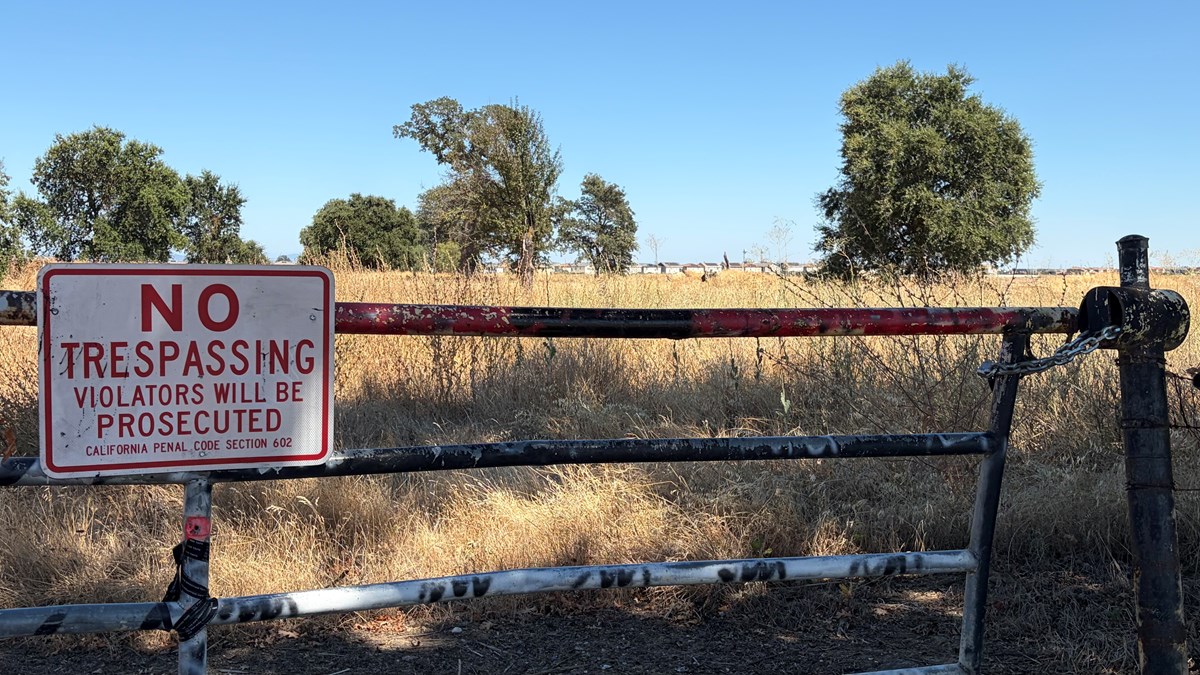 A padlocked gate blocks the entrance to the Phillip Road site in west Roseville on July 9, 2026. The city owns the roughly 240-acre parcel, which developer Panattoni has proposed for housing, retail and a million square feet of an innovation center.Greg Micek/CapRadio
The City of Roseville owns the land. In 2021, the city council declared sale of the property in the city's interest and signed an option and purchase agreement with Panattoni Development, which wants to build about 660 homes, a park, shops, medical offices, and just over a million square feet of buildings the plans call ‘an innovation center.’ The sale hasn't closed. The city is both the seller and the agency reviewing the application.
But nothing has been built. Nothing has been approved. No data center has been proposed. No tenant has been identified, and no hearing has been scheduled.
Josh Hickson has been watching anyway. He moved into the neighborhood in 2022, and early the next year a neighbor knocked on his door with flyers about an industrial park planned for the field.
"I started going to neighborhood association meetings," Hickson said. "It was kind of just interesting how local representatives voiced support for this project, despite it being halfway through the CEQA process, environmental review."
That proposal drew enough opposition, most of it over truck traffic, that Panattoni withdrew it and started over.
When the city issued a notice of preparation for the new plan in 2025, Hickson read the documents and looked up the developer. He found one of the country's largest industrial builders, which had launched a data center division the year before.
He wrote the city a letter. It asked officials to say plainly whether a data center was coming to Phillip Road.
The draft environmental report that followed lists its own areas of controversy. The first one is concern about what the new zoning would allow.
Roseville isn't the only place having a data center argument. More than 70 cities and counties now restrict new data centers in some form, among them Denver, Minneapolis and New Orleans. On June 2, Monterey Park became the first city in the country to ban them by popular vote — 86% of voters approved a measure killing a 250,000-square-foot proposal. Last month Seattle's council voted unanimously to freeze new facilities above 20 megavolt-amperes — roughly 20 megawatts — for a year. Fifty-two people testified. Not one spoke in favor.
The data center backlash has grown consequential enough to move elections in other states, according to a March report from the Little Hoover Commission, an independent state oversight agency that spent last fall studying what data centers mean for California's electricity system. Policymakers, the commission warned, "may face pressure to defer to powerful technology companies and utilities."
“How close is this to my community?”
Before Rachel Davis and her family moved to West Roseville, she knocked on neighbors' doors, called school districts, read environmental reports. But she never heard of the Phillip Road site.
In June a friend forwarded a Reddit post to her.
The post ran on Roseville's subreddit under the headline "I found plans for an AI Data Center in West Roseville." It drew hundreds of replies. Some were careful, others less so. One commenter called data centers instruments of mass surveillance. Another suggested blowing it up. Several pushed back, pointing out that data centers have operated quietly in Roseville for years, and that the same infrastructure carries everyone's email and streaming video.
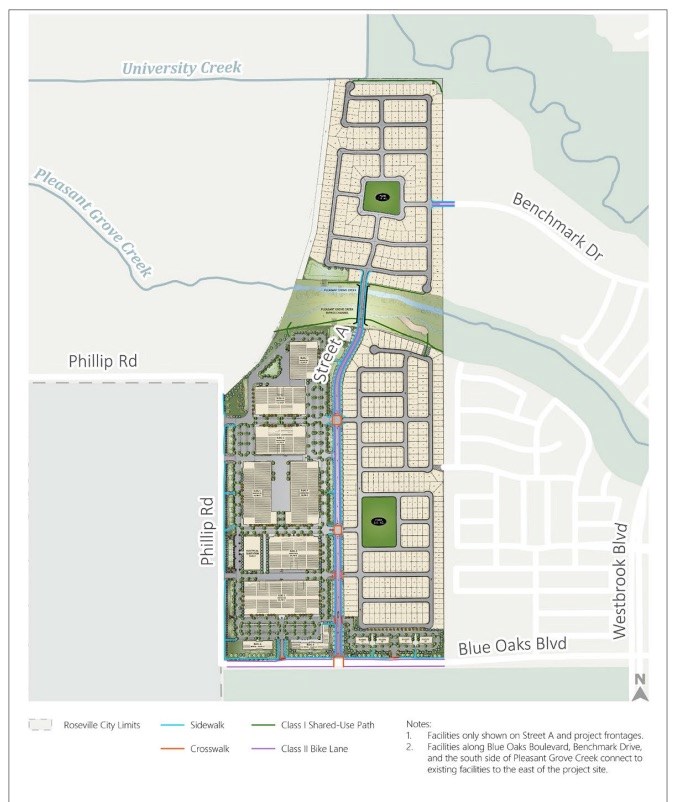 A site plan showing proposed bicycle and pedestrian routes for the Phillip Road project, with housing along the eastern edge and commercial and innovation center buildings to the west. The plan is from the draft environmental impact report.Ascent / City of Roseville
By the time Davis read it, the public comment period on the Phillip Road site environmental report had been closed for weeks.
"My initial reaction was, ‘How close is this to my community?’" she said. She typed the address into Google Maps. A few miles.
Davis went looking for paperwork and context.
"On social media, it's easy to become a little bit alarmist, and people are happy to give their opinion," she said. "But I think it's also important to do something about it and to do your own research and diligence."
What she did was start converting the alarm into arithmetic. She found Seattle’s data center freeze. "The potential data center in the Phillip location would actually not be permitted under that new legislation in Seattle," she said.
Underneath the noise, the specific data center fears are consistent. Electricity bills. Water. Diesel generators near schools. Noise. Property values. And running through all of it, a suspicion that the decision has already been made somewhere nobody was invited.
"I want to make sure that construction doesn't start and 90% of families in West Roseville are like, 'What is going there?'" Davis said. "And it's too late before people can really have their voices heard."
A hyperscale concern
Roseville's answer arrived days after the Reddit post, in an updated FAQ on the city's website. A hyperscale data center at the Phillip Road Site, it said, is not planned, and not possible.
Those facilities can draw upward of 200 or 300 megawatts, the city said. Roseville's peak demand across the entire city is about 370 megawatts. Roseville runs its own electric utility, and it says the local grid was never built for hyperscale-level load.
But running its own utility is part of what makes a city attractive to data centers in the first place. Municipal utilities tend to charge less for power than PG&E does — one reason California's data centers have clustered in Santa Clara and Los Angeles, according to the Little Hoover Commission. Both cities, like Roseville, run their own.
But "hyperscale" describes scale. It’s not a building type and not a zoning category, and neither is "AI data center," a phrase that describes what the machines inside are computing.
Khara Boender spends her days explaining that distinction. She’s director of western state government affairs for the Data Center Coalition, the industry's national trade association.
"The conversation today really is almost putting data centers and AI as being synonymous," Boender said. "But I would say that that is not a true reflection of everything that data centers support."
"The term cloud almost feels like a misnomer, because it almost implies that all that data is just going out into thin air," Boender added. "But it turns out that that data is going into a physical structure. And that physical structure is a data center."
Boender said artificial intelligence drives roughly 20% to 25% of data center demand today, and that industry projections don't show an even split with conventional cloud computing until about 2030. The rest is streaming, online banking, telehealth, the average American household's 21 connected devices.
Data centers also vary enormously. Roseville's own FAQ makes the point: data centers "range in size and type, and many of them are small-scale facilities and may even exist within a building or business where you work."
Roseville has several along Foothills Boulevard. The largest in the Sacramento region is a 52.7-megawatt campus near Natomas run by NTT. Most of the rest fall between 3 and 26 megawatts.
At 30 megawatts, a data center at Phillip Road would be smaller than a hyperscale campus by an order of magnitude, but still larger than nearly everything already operating in the region.
Davis, who has spent much of her career in accounting for technology companies, said the vocabulary is a problem.
"There's a lot of buzzwords going around, right? Like AI, hyperscale," she said. Rather than the buzzwords, "just look at the numbers behind everything." Size is relative, she said. "If you're okay with a 30 or 40 megawatt data center next to your home, that's great. But I do think you have the right to know and make that decision for yourself."
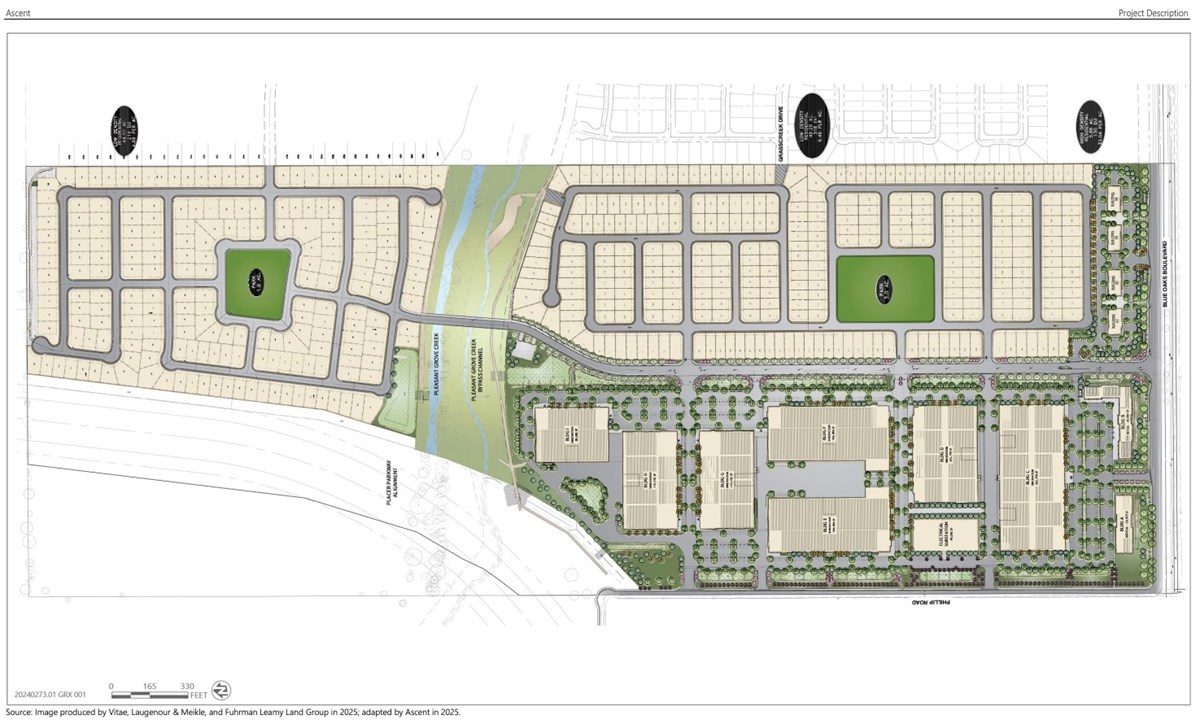 Illustrative site plan for the Phillip Road project in west Roseville shows existing homes in gray at top, with proposed housing and innovation center buildings in color. The plan was included in the February 2026 draft environmental impact report.
What's on paper
The Phillip Road project's draft environmental report, published in February, is where residents went looking. It describes no hyperscale facility, but does consider a smaller one.
The report's zoning table contains no line for a data center. It contains a line for "specialized industrial," and a footnote defining that term to include one.
While the report is vague about what would go in the innovation center, it is specific about what a data center there would need. Its air quality and energy chapters assume 15 diesel generators of three megawatts each, "to provide power to the future potential data center." They would be backup, for outages. The report requires the cleanest tier of engine, because without it, it calculates, cancer risk at the most exposed nearby home would exceed Placer County's threshold.
Backup generators are the most significant community risk the Little Hoover Commission identified. Its report cites a proposed hyperscale facility in San Jose that would run 39 of them — enough, by the California Energy Commission's estimate, to emit as much air pollution in 20 hours a year as 428 cars driven for a year. It also notes that the EPA recently clarified data center generators may run a set number of hours outside emergencies, and without limit during them. The commission recommends the state limit what those generators do to surrounding neighborhoods.
The report's utilities chapter budgets 538 acre-feet of recycled water a year for "the data center cooling system," if one is built — roughly 175 million gallons, more than the rest of the site's development would use. It would come from the city's recycled water system through pipes Panattoni would build along Blue Oaks Boulevard. The report finds the supply sufficient.
How much water that is depends on who's measuring. The Little Hoover Commission puts a typical data center's use at roughly what 1,000 homes consume in a year, and a hyperscale facility's at about a town of 50,000. By that yardstick, Phillip Road would land somewhere near 1,500 homes — more than typical, but nowhere near hyperscale.
Boender, with the datacenter trade association, offers a different yardstick. She points to a 2024 Virginia legislative study of the nation's largest data center market, which found 83% of the data centers there use no more water than a large commercial office building — about 6.7 million gallons a year.
By that measure, the facility considered for Phillip Road would use roughly 26 times what a large office building uses.
None of that means a data center is coming to Phillip Road. Environmental reports study the most intensive version of what the zoning would permit, whether or not it happens. The city makes the point directly: the studies "examine a scenario with the maximum potential impact that could occur," its FAQ says, and that "doesn't necessarily mean that the scenario will definitely occur."
The city says any data center would be capped at 30 megawatts and restricted to recycled water. The new zoning would bar warehouses outright, a concession Panattoni made when it redesigned its plans for the site.
Skepticism over reassurance
Hickson read the Roseville’s FAQ and noticed its phrasing. The question "Is a hyperscale data center planned?" is answered no. The question directly beneath it says a 30-megawatt data center could be.
"The structure of the city's FAQs really strongly implies that there isn't going to be a data center," he said, "until you actually do the reading."
He tested that on his neighbors. "I've talked to a handful of neighbors, and I've showed them the FAQs," Hickson said. The ones who read it, he said, stopped at the first question. "If you go on Facebook, if you go on Nextdoor, you'll find a lot of people saying, 'Oh, there's not going to be a data center put here.'"
His skepticism predates the FAQ. In the summer of 2023, with the industrial park in trouble, Panattoni started asking neighbors what they wanted on the land. The developer held 12 public workshops that summer, according to February’s draft environmental report, followed by an open house that fall and two more the next spring.
Hickson said he remembers poster boards and sticky notes in neighbors' living rooms and in community rooms at local stores.
"It kind of felt disingenuous, because it wasn't an official survey or anything," he said. "It was just post-its and markers, and it was divisive because people wanted different things."
He also doesn't pretend to be confused about the developer's motives.
"Panattoni's an industrial developer, so they have industrial goals," Hickson said. "At the end of the day, they want to make a profit with the land that they've entered into a sale contract with."
Panattoni is one of the country's largest industrial builders, and in 2024 it launched a data center division. Its website advertises a global pipeline of more than five gigawatts across 20 countries, and says its data center projects "range from 100 MW to 1+ GW." One of them, in Van Buren Township, Michigan, is a full gigawatt.
Thirty megawatts would be below the floor of what Panattoni's data center group says it builds.
A representative from the city of Roseville declined an interview, citing the ongoing review. "As part of this review, the City is required to evaluate a variety of potential uses, whether or not they move forward," wrote Erin Dunlay, the city's public affairs and communications manager.
Panattoni declined an interview as well. In a written statement, a company spokesperson pointed to the project's website. "We are committed to transparency and encourage community members to explore the information available, share their feedback, and stay engaged throughout the planning process. We value the perspectives of our neighbors and are committed to an open dialogue as we continue planning for Roseville's long-term economic growth and quality of life."
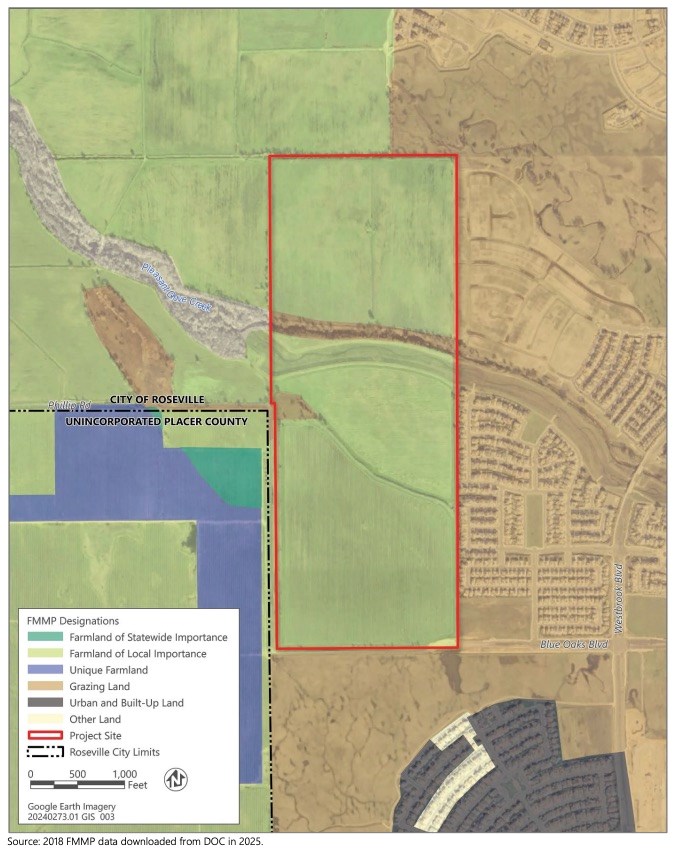 The Phillip Road site, outlined in red, sits between existing west Roseville housing to the east and farmland to the west. The map is from a draft environmental impact report prepared for the City of Roseville by the consulting firm Ascent.