By Lasherica Thornton, EdSource
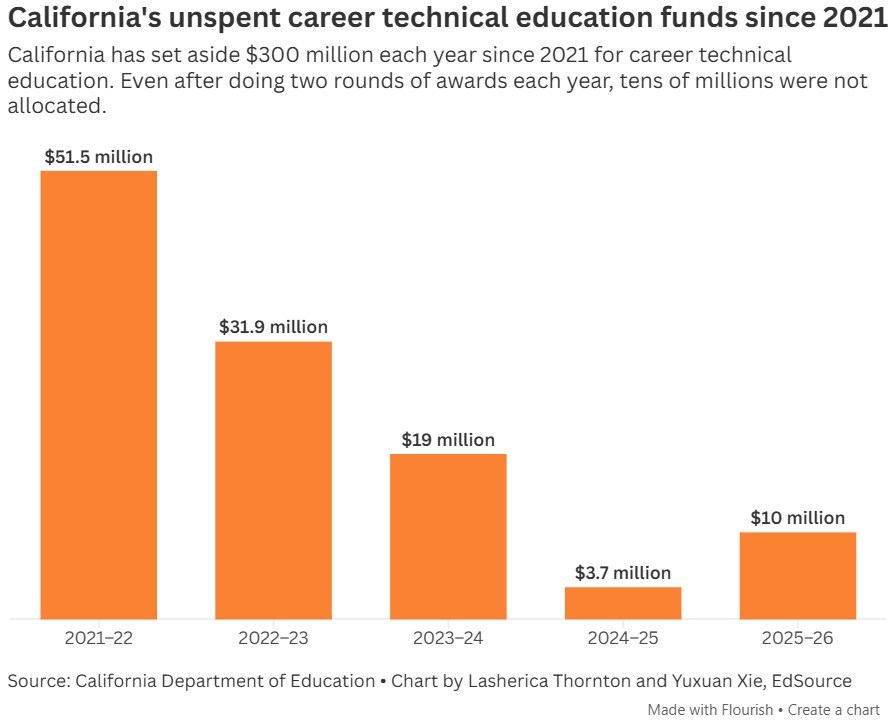
California has invested heavily in career technical education, earmarking $300 million annually since 2021 to help schools prepare students for jobs in fields such as healthcare, public safety and engineering.
Yet, over the past five years, more than $115 million of that funding — an average of $23 million per year — never reached schools.
District leaders, advocates and legislators say the shortfall stems from the state’s allocation formula that does not fully distribute the career technical education, or CTE, funds.
Lawmakers are advancing Assembly Bill 1590 to ensure all available CTE funding makes it to districts going forward. Some relief may come even sooner; districts that applied for funding for the 2026-27 school year will see all of the money distributed.
The bill’s author, Assemblymember Rhodesia Ransom, D-Stockton, said the current formula for allocating CTE money has left many schools unable to support career education programs.
“It makes everybody scale back; that makes them have fewer certification programs, fewer learning opportunities and, then, fewer pathways,” Ransom said. “To me, that’s something that needed to be corrected.”
Why millions of dollars don’t make it to districts
The CTE funding program requires school districts to provide a 2-to-1 match, meaning for every dollar they receive from the state, they must contribute $2. A district seeking $1 million in state funding, for example, must provide a $2 million local match.
But if districts are unable to meet the match, the money reverts to the state’s General Fund rather than back into the pool of CTE funding where it can be redistributed to districts that could use it.
That is problematic, some educators and advocates say, because it leaves money on the table even as many other districts have available matching funds for career education programs.
For example, in 2025, Merced Union High School District in the San Joaquin Valley applied for $6.7 million in CTE funding but received $1.7 million — $5 million less despite having the matching funds.
California Department of Education officials said districts often receive less than they request because demand exceeds available funding, the number of applicants changes each year, and the allocation formula, itself.
It’s a formula that’s been debated many times since CTE money became an ongoing funding source in 2018. The department told EdSource it was determined to be the “most equitable and efficient mechanism” for maximizing CTE funds.
Educators and advocates, however, say the formula disadvantages smaller districts. The formula recognizes very small districts through its first two funding categories, but once a district exceeds an Average Daily Attendance of 550 students, it is grouped into the largest category, said Nicole Newman, president of the Small School Districts Association.
Districts with an ADA of 550 to 2,500 face the same challenges as smaller school systems and must compete with a broader range of districts. These districts often have limited administrative staff, a lack of grant-writing resources, difficulty recruiting CTE teachers, minimal access to industry partners and postsecondary institutions, and smaller local tax bases, Newman said.
“A district with 600, 1,200 or 2,000 students competes within the same funding category as some of the largest school systems in the nation,” Newman said.
The allocation formula, established by the state superintendent and State Board of Education, distributes 70% of funding based on district size, measured by ADA of students in grades 7-12. The remaining 30% is distributed using factors such as the number of vulnerable student populations, higher than average dropout rates and an area’s high unemployment rate, among others.
Limited opportunities when funding is left on the table
With CTE grant funding, not only do funds remain unallocated, the money going to districts is not consistent each year.
In Contra Costa County, located in the East Bay, a consortium of 10 school districts has built a robust CTE network offering about 300 classes and early childhood education apprenticeships, said Hilary Dito, director for college and career readiness at the county education office. In 2025, the consortium received $6.2 million, about $500,000 less than the year before.
As a result of the drop, the county education office imposed a 17% reduction across the board. The county won’t be able to offer 300 classes next school year. At the district level, some school systems will not hire for positions vacated by retiring CTE teachers. There will be cuts to robotics, culinary arts and digital photography programs.
Dito worries those cuts will limit opportunities for students to figure out what they want to pursue.
“One of our students from last year, senior year, got into a digital recording arts class,” she said. “Before that, (they) had no clue what they wanted to do. Now they’re at the community college with the same teacher. Without that class, I don’t know if that student would’ve found that path. These are the programs that can change someone’s life.”
When funding is uncertain or inconsistent, districts struggle to sustain program offerings and create and scale industry partnerships, dual enrollment, internships and job shadowing opportunities, educators said.
“Stability matters just as much,” said Newman, who is also superintendent of Wheatland Union High School District in Yuba City. “High-quality CTE programs take years to develop.”
Newman said her 1,200-student district would like to expand its agriculture pathway with updated facilities, new equipment and more livestock, but roughly $300,000 in state funding is barely enough to sustain existing programs.
Immediate, but temporary, relief in sight
Ransom’s bill would require the state to revise the allocation formula so that all CTE money is distributed to eligible districts.
Districts may see some immediate relief. For the 2026-27 funding cycle, all $450 million available, a one-time increase of $150 million for CTE grants this year, will be distributed to districts. State officials have not explained how that will happen. In previous years, the state has done two rounds of award allocations that still left money untouched. The $450 million is expected to be allocated in a single round.
“If the dollars are available,” Ransom said, “we want them to reach the programs.”
Follow us for more stories like this
CapRadio provides a trusted source of news because of you. As a nonprofit organization, donations from people like you sustain the journalism that allows us to discover stories that are important to our audience. If you believe in what we do and support our mission, please donate today.
Donate Today