Climate experts said El Niño likely means that a very different winter is looming. As opposed to this year’s wet but short-lived season, they anticipate several potential impacts: more intense atmospheric rivers, major snow events in the Sierra Nevada, larger waves, coastal flooding, mudslides, higher sea levels and reduced wildfire risk.
“This El Niño is developing unusually fast,” AccuWeather expert meteorologist Paul Pastelok said in a statement. “Most El Niños begin in the fall. This one should start in June and strengthen quickly.”
Pastelok said there’s a 40% chance that a super El Niño will form this year, which has only occurred seven times in modern history. The rare event was last documented in the winter of 2015.
“That bar is difficult to reach, so current factors contributing to the development need to continue in the second half of 2026 to allow it to build,” Pastelok said.
Barnard said El Niño could also temporarily raise sea levels by half a foot or more. This means that places like Pacifica, Sausalito, San Francisco and San Rafael, which already flood during king tides, could experience even worse inundation this winter.
Barnard said that conditions this winter could be a “precursor to what we can expect to have almost every single winter” in the coming decades.
The Pacific Ocean has risen by about 8 inches since the 1880s. State scientists project an additional rise of over a foot by 2050, and in worst-case scenarios, up to 6 feet or more by the end of the century.
Barnard said that for every couple of inches of sea level rise, the risk of coastal flooding doubles. And with up to a foot of this temporary rise, “the probability of flooding goes up exponentially.”
“We’ve built up so much of our communities right in this razor-thin margin of the sea, and so when all of a sudden you raise that base level by 6 to 12 inches, you’re really putting a lot of assets in harm’s way,” Barnard said.
When it comes to potential storms this winter, Barnard said the effects of human-caused climate change are pushing the jet stream closer to the poles, which means the effects of El Niño, primarily intensified storms, could shift north to the Bay Area rather than focusing on Southern California.
“The biggest El Niño impacts are moving more to the north than they did 50 years ago,” Barnard said. “We’re just looking at a different climate as a starting point when the onset of El Niño conditions hit us.”
AccuWeather’s Roys said that at this point, it’s “very difficult” to know exactly how intense this winter’s storms will be.
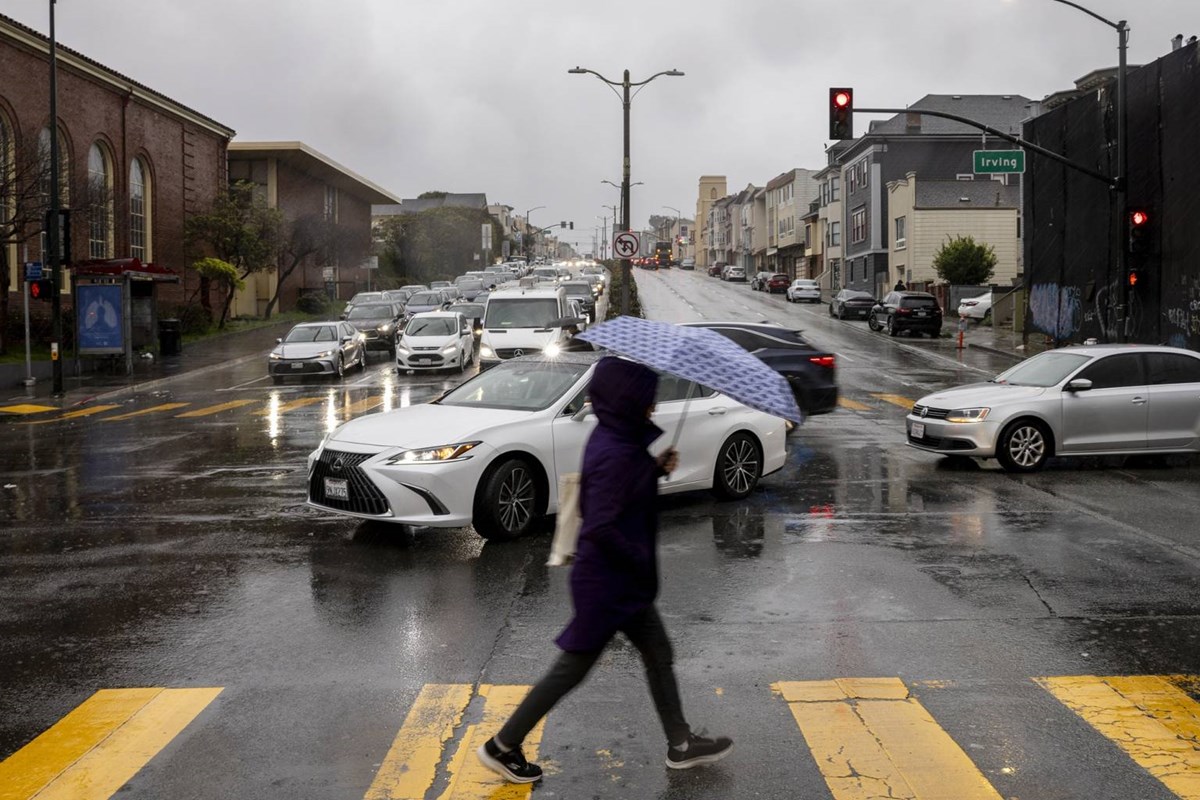 A pedestrian crosses a rain-soaked 19th Avenue amidst the ongoing winter storm in San Francisco on Feb. 17, 2026.Stephen Lam/San Francisco Chronicle via Getty Images
“It won’t change the number [of storms] that occur, but the intensity is likely to vary towards the higher side,” Roys said.
Roys said El Niño could shorten the wildfire season this winter, if the rains truly show up in force across the state.
“If the ground is more saturated, things don’t dry out, and when things don’t necessarily dry out, it doesn’t become fuel and fire won’t spread as fast,” Roys said.
Roys also noted that El Niño isn’t the only global weather factor altering weather patterns.
“It’s kind of like when you’re cooking, one ingredient can overpower another one,” Roys said. “What we’re still figuring out for the fall and for the winter is how that’s all going to play out.”