By Vani Sanganeria, EdSource
A statewide initiative to help university dropouts reenroll and complete their degrees has cultivated a promising playbook that could raise California’s postsecondary attainment rates, according to a new study.
The California Reconnect program has outperformed state and national benchmarks for reengaging students who “stopped out,” meaning they obtained some college credits but did not complete a degree, a study by nonprofit research firm Education Northwest found. The program has achieved an overall reenrollment rate of 8.15% across a pool of more than 25,000 learners — nearly three times California’s statewide average of 2.9% and the national average of 2.7%.
“California is showing a path forward for reaching the adults who started college and never finished,” said Leanne Davis, researcher and author of the study. “What’s striking is not just that coaching works, but how consistently it works — across different institutions, different demographics and different points of stop-out.”
In California, more than 5.9 million adults under age 65 have some college credit but no degree. Despite making progress in reengaging students, California will likely not reach its targeted 70% student attainment rate by 2030. Achieving that goal would yield about $4.4 trillion in net economic gains for the state over the next 50 years, according to the Georgetown Center on Education and the Workforce.
Ruth Bauer, president of InsideTrack, an Oregon-based higher education nonprofit that oversees the California Reconnect initiative, attributed the program’s results to a multistep process.
First, counselors and specialists make persistent efforts to reach and stay in contact with lapsed students, she said. Then, they work with public colleges and universities to create paths toward completion, connect students to financial aid and help them find ways to balance school with other life priorities.
Adult learners most often leave college because of financial pressure, work obligations, family and caregiving responsibilities and poor mental health or stress.
“Most of the students we work with are adults, so they have a lot of competing priorities,” Bauer said. “And higher education is often structured for the traditional student that is focused solely on school.”
For many students, going back to school marks the culmination of a deeply personal journey.
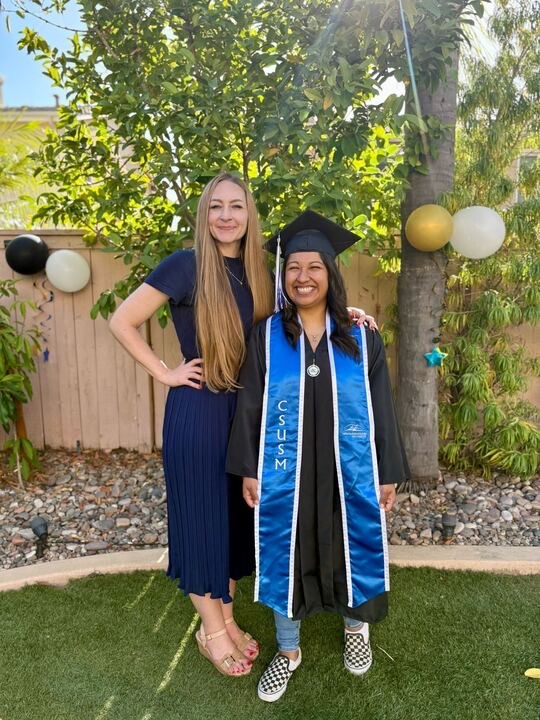 Jaima Mavity (left) attends her student Nancy Palacios’ (right) graduation in May.Courtesy of Jaima Mavity
Jaima Mavity, a student success specialist at InsideTrack, said one student she first reached out to last spring, Nanci Palacios, graduated from CSU San Marcos last week and now plans to attend graduate school for social work. Palacios had dropped out of college for two years due to mental health struggles and her father’s cancer diagnosis.
During the reengagement process, Palacios’ self-doubt turned to resilience, Mavity said.
“She had this understanding that she had the power inside of her as a student to continue moving forward,” Mavity said.
Getting students back in the door
Bauer said the first step to reengaging students is effective outreach. California Reconnect reached adult learners through email, phone calls and text messages. About 85% of students responded to a reenrollment pitch via text.
“Colleges are often designing their outreach around what is most convenient for them. Email is cheap, scalable, but most of the students we’re trying to reach had stopped checking their student email accounts,” said Davis. “A text message meets people where they actually are, and it’s a lot lower stakes.”
The study pointed to ongoing support as the next driver of both reenrollment and retention. Students who received one-on-one support returned to college at a rate of 19%, compared to 4.5% of those who did not receive support.
Adult learners in the program were also more likely to stay enrolled and complete their degrees. More than one-third of learners who received coaching stayed for the subsequent academic term, compared to about one-fifth who reenrolled but did not meet with a coach.
To keep students enrolled, Davis said colleges should provide ongoing and focused support to returning students, prioritize learners closest to degree completion and connect reenrolled students to more career services and workforce pathways.
Colleges that retained more reenrolled students, for example, had a dedicated reenrollment staff, active coordination with coaches and technical assistance for returning students, Davis said. At colleges with lower retention rates, students often run into “a series of bureaucratic frictions,” such as long holds or unclear advising pathways, she said.
“Coaches could really help get people in the door, but they can’t substitute for the institutional readiness on the other side that has to meet the students and help keep them there,” Davis said.
Beyond surface-level support
First-generation and Hispanic students, who are more likely to stop going to college than other populations, also showed the highest gains in reenrollment, according to the study. First-generation students comprised nearly two-thirds of all learners who persisted after reenrolling. Hispanic students, who represent the state’s largest undergraduate population, comprised 43% of reenrolled students and nearly half of those who stayed enrolled.
But financial pressures remain one of the top barriers for all students who want to reenroll. The cost of attending college continues to rise in California, and rising expenses can make it harder for adult learners to afford to go back.
“What has stayed the same is when you hear that cost is a barrier, maybe it’s about the fact that childcare is more expensive than it is about tuition, or it could be that they have to cut back on their hours at work in order to handle the workload,” Bauer said.
In response to financial pressures, Mavity said she has seen more of her students reenroll in affordable programs at community colleges rather than four-year public universities. She also pointed to mental health and accessibility issues as more common reasons that students have stopped attending college in recent years.
“What I’ve seen change is that colleges are offering more counseling and mental health support, things like student accessibility services,” Mavity said, adding that these resources are often key factors in a student’s decision to return.
In an effort to boost enrollment, California has streamlined college entry with policies such as automatic admissions. Bauer said state leaders need to invest equally in maintaining that enrollment.
“It’s a continual issue that schools face, and reenrolling students will help them financially, but they have to invest in the resources to do it first before they get that benefit,” Bauer said.
Follow us for more stories like this
CapRadio provides a trusted source of news because of you. As a nonprofit organization, donations from people like you sustain the journalism that allows us to discover stories that are important to our audience. If you believe in what we do and support our mission, please donate today.
Donate Today