The Iran war is approaching its second month, after U.S. and Israeli forces launched military strikes in late February.
The conflict has since spread across the Gulf, involving more than a dozen countries and killing thousands of people.
A tenuous ceasefire announced two weeks ago has been extended, but much uncertainty remains over ongoing military activity and peace talks between the United States, Iran and other parties.
The conflict has ignited strong feelings across the diverse Iranian diaspora, as well as sparked concerns and debates over the appropriateness of foreign intervention, calls for regime change, and the protection of protestors, dissidents and minority groups within Iran.
Dr. Hengameh Roohi is an Iranian-born clinical psychologist living in the Sacramento area and a member of the Baháʼí Faith, the largest non-Muslim religious minority in Iran. Roohi spoke with Insight Host Vicki Gonzalez about her experience growing up in the country, and how she centers human rights in the midst of war.
This interview has been edited for length and clarity.
Interview highlights
Tell us a little bit more about yourself, and how you came to the United States?
I was born in an ancient beauty called Iran, born and raised in the Baháʼí family and grew up there, and then I became Baháʼí myself. The Baháʼí Faith is a minority religion that in Iran after [the] 1979 revolution, they don't have most of the citizen rights. Education is one of those; Baháʼís in Iran to this day, over the past 47 years, don't have education beyond high school. There’s no college or university. So I left Iran to pursue education when I was 21 years old… I came to America, pursued my education, became a clinical psychologist.
I would imagine that experience from your youth and early adulthood shaped what you wanted to do with your future.
Absolutely. I think it's the combination of psychology and my passion for social justice. I was born right at the time of [the] 1979 revolution.
A little background about Baháʼí Faith; [it] is a global religion that emerged in the 19th century in Iran. The fundamental principle of Baháʼí Faith is the oneness of the human race. It envisions a future world order where all racial and religious prejudice are abolished, and all nations can just join together in unity. That concept of unity and the future of the world order, that there is social justice, is very close to my heart.
But after the 1979 revolution it was an official order to revoke the citizen rights from Baháʼís. My very first experience of that, I was four-and-a-half years old in June of 1983. There was an order for execution of [a] number of Baháʼís in my hometown and across Iran. Imagine at that age, my mom is trying to explain to me what it means for Baháʼís, just for their belief system, to be executed. That led me to so many other events, and to my choice for psychology.
Did that persecution continue for decades past the 1979 revolution, until today?
The persecution is not just now for Baháʼís, but it started with that minority group and it still continues. It was an official order that they had to do. Economic strangulation, they were fired from all government jobs, education denial. If they had their own business [there was] confiscation of their property. Torture, forced confession, execution, imprisonment.
The thing is, the Baháʼí Faith [stays completely] non-partisan… fundamentally is against war and violence. The approach is the way of worshipping God is to be at the service of humanity. Community building, anything Baháʼís do in Iran has been banned and stopped.
It starts with one minority group, but when violation of human rights is not held accountable in a right way, it just doesn't stay in one place. It expands. It continues to different groups; journalists, students, whoever doesn’t really align with the dominant ideology.
It’s been almost two months since the war started. How has that time been for you?
From [a] psychology perspective I would say that in order to really manage this level of contention and this level of anxiety is to be able to actually hold the complexity that two realities can exist at the same time. For me it’s been sadness and the sorrow of watching my beloved country going through this. At the same time, hoping that there will be a place that human rights are valuable. I'm trying to hold the tension between hope and sorrow.
Do you think there’s a focus on human rights when it comes to the coverage of this war?
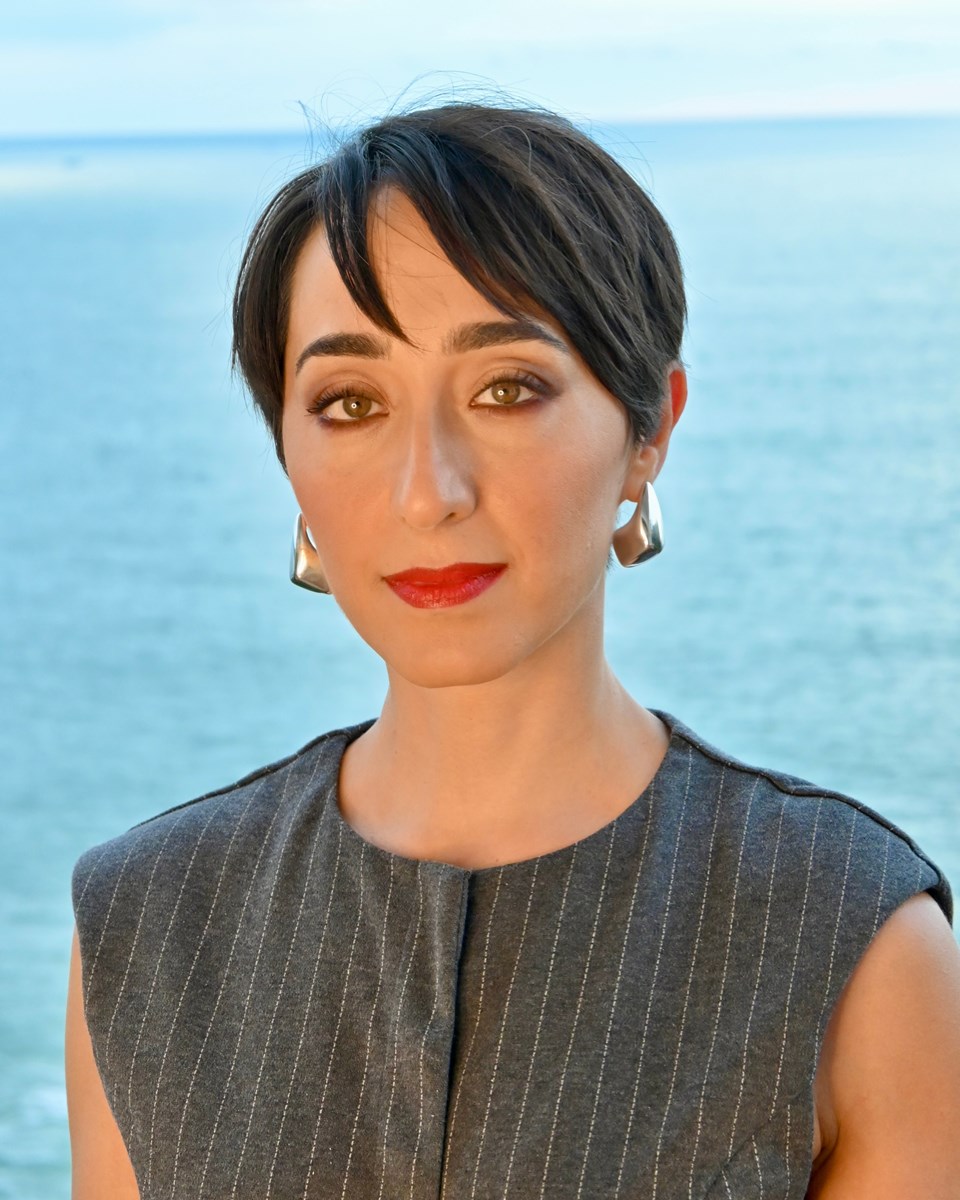 Dr. Hengameh Roohi is a clinical psychologist in the Sacramento region. She was born in Iran as a member of the Baha'i Faith.Courtesy of Dr. Hengameh Roohi
This isn't new, this isn't just about the past two months. Violation of human rights, it's been going on over the past 47 years. And the news, or even people when we talk about it, it’s just mentioned in a very light way, and the focus is a lot on who are we hating, who we don't like, which party is right, which party is not right. If we really drop all this and connect with the universal truth, which is the human dimension aspect, everything else falls away and it just makes sense.
I don't think that the emphasis is on the violation of human rights. We hear so much about the Strait of Hormuz, the nuclear bomb, Democrats or Republicans… but let’s just get rid of all that and ask the question, “what is really happening on the ground with Iranian people?”
We had in January, nurses were getting raped at the hospital [where] they were treating wounded protesters. There's mass executions still going on. Those topics are not coming up in media… a lot of Iranians are talking about that. Let's just, all of us, unite and think about this human aspect of that. It’s real.
Do you have a Baháʼí or Iranian community here that you can lean on during this time?
We have a beautiful Baháʼí community here in Sacramento; it’s large in America and California, it’s across the world. I do have amazing, wonderful Iranian Baháʼí friends, non-Iranian friends that have been supportive. But I often have these conversations, especially [with] my non-Iranian friends that are concerned about the war and everything. I try to just bring their attention, everyone’s attention — even my Iranian Baháʼí friends who were born and raised here, and don't really have the experience of what it means to live in Iran under those situations — that let's just stay with this important part. Let’s just think about the violation of human rights.
What gives you the most hope?
I'm fundamentally against war, everybody is. Nobody wants to see the invasion of their country. But knowing that there is some intervention, some action is taken. If you go back to 2022 during Woman, Life, Freedom which could have been the first woman-led revolution, if there was any attention of foreign policy. And again not for the revolution aspect of it, but from the aspect of woman empowerment and the movement, and how big it was.
And unfortunately there was no intervention. It was just mainly Iranians screaming, asking for help. It was brought up to the United Nations but there was no intervention. So it seems, as painful as it is to watch what’s going on right now in the war, there is some sense of hope that maybe there might be good intervention here.
You’re a clinical psychologist. Have you been putting your professional work and experience into practice during this time?
As a professional psychologist I try to really use this silver lining, let’s just be able to put the hate, contention and disagreement aside and be able to tolerate the complexity. To hold multiple realities at once without immediately needing to reduce the anxiety that we have into a simple category of what's right and what's wrong. So for me that also connects with a broader perspective that emphasizes unity and non-partisanship. Not in the sense of disengaging, but staying anchored in human dignity rather than taking a side.
There is a Baháʼí quotation, “be anxiously concerned about the need of the age you live in.” That's very much a psychological perspective; I’m responding to the meaning of life that is presented — to focus on violation of human rights and then everything else makes sense to me. That’s where my heart will find solace.
Follow us for more stories like this
CapRadio provides a trusted source of news because of you. As a nonprofit organization, donations from people like you sustain the journalism that allows us to discover stories that are important to our audience. If you believe in what we do and support our mission, please donate today.
Donate Today