The Sacramento City Council voted Tuesday to ban overnight camping outside City Hall, ending a policy made in 2018 that allowed people to sleep on the property from 9 p.m. to 6 a.m. Supporters cited safety and sanitation concerns, and opponents warned that it would push vulnerable residents into more dangerous areas.
Mayor Kevin McCarty introduced the ordinance, saying the goal was to make the area safer for staff and the public. He said the city would work to inform those who regularly stay outside City Hall and offer them shelter and outreach services.
"We’re saving to not have to power wash literally feces and urine from the sidewalks every morning," McCarty said in a previous interview with CapRadio. "We can redirect and have more programs for people to go to who are homeless."
The ordinance passed in a 6 to 3 vote, with Mayor McCarty and council members Phil Pluckebaum, Rick Jennings, Eric Guerra, Roger Dickinson, and Karina Talamantes voting yes, and council members Lisa Kaplan, Caity Maple, and Mai Vang voting no.
Under the new rules, people who sit or lie down outside City Hall at any time of day could face citations, misdemeanor charges, or civil penalties ranging from $250 to $25,000. The mayor says he wanted to make this change to be in line with other state and federal buildings that don’t allow camping. The change will go into effect on August 28.
 Sacramento Mayor Kevin McCarty speaks during the City Council meeting at City Hall on Tuesday, July 29, 2025. The council voted 6–3 to approve a controversial overnight camping ban.CapRadio/Tony Rodriguez
 Unhoused residents say safety and community will be lost
Each morning before the sun is up, Allen Miller packs up his belongings and prepares to leave from outside Sacramento City Hall. He’s been experiencing homelessness in Sacramento for a few years now and uses City Hall as a place to feel secure while he rests.
"It is safety," he said. "I've never had a problem getting robbed or anything."
Miller typically sleeps right in front of the door of the building and said the sound of classical music over the plaza that the city plays on the loudspeakers tells him it’s time to go.
"I get up at 5:30 when the music comes on, the opera music, the classical music," he said. "When that comes on, I leave."
He said the speakers are loud enough to wake people who sleep nearby.
After the vote, Miller said he may stay with his sister in the Bay Area while the new rules take effect. But he said not everyone has that option.
Jessica Davila has slept outside City Hall for several months with her husband, saying the cameras and lights make her feel safe. Davila said being a disabled woman makes her more vulnerable than most.
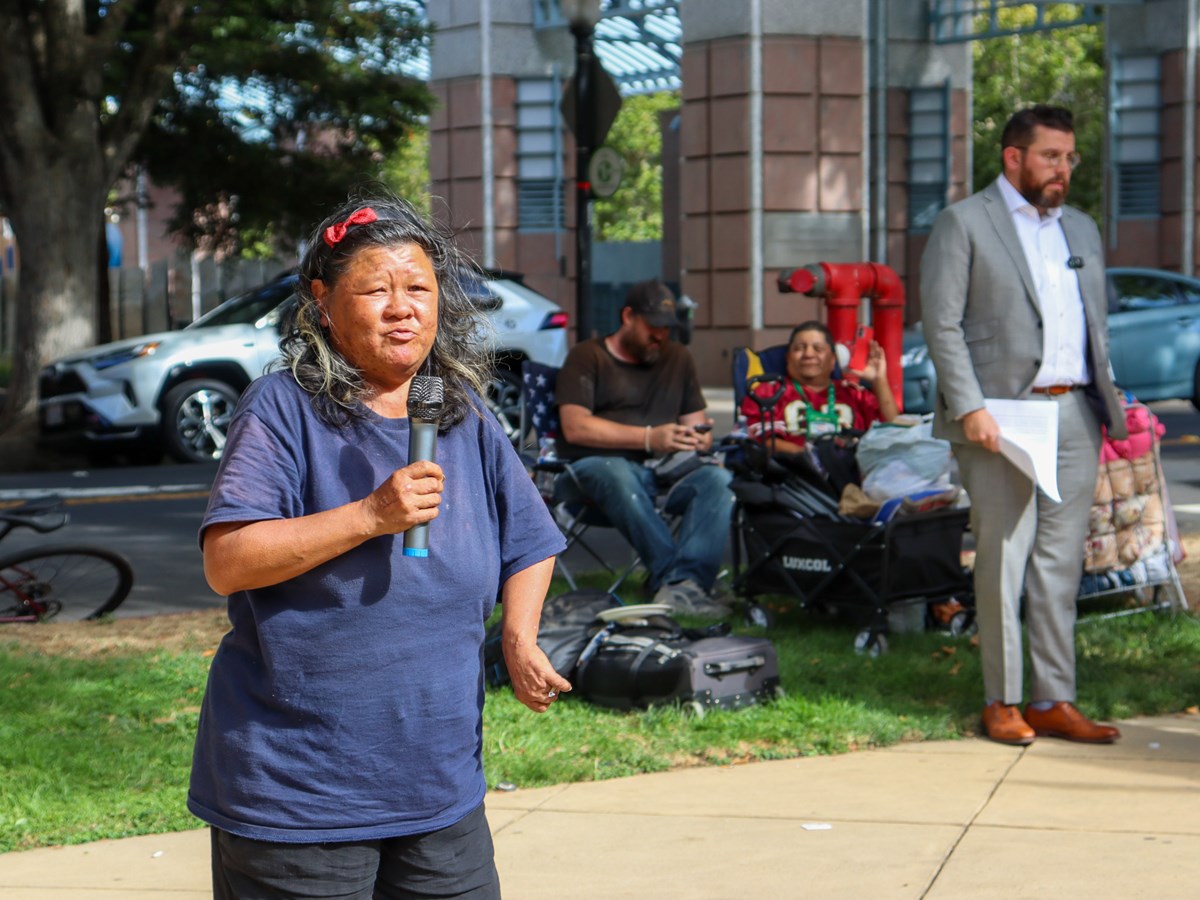 Jessica Davila speaks outside Sacramento City Hall on Tuesday, July 29, 2025. Davila and her husband sleep outside the building.CapRadio/Tony Rodriguez
"I'm thinking of going somewhere else, but anywhere we go, we have to leave every single day. I mean, it's hard to move everything we have, a shopping cart, the wagon, and we have to move every day, and there's nowhere to go," she said.
Davila said the people who sleep outside City Hall often look out for each other.
Regina Brink, a blind and disabled woman, was one of the first public speakers to talk to the council. She shared statistics on how disabled people are disproportionately affected by homelessness, and said banning camping would result in removing people like her.
After giving her remarks, Brink remained seated in quiet protest next to the podium for the duration of public comment, a full two hours. She said she did this so council members could witness what displacement looks like.
"I want you to see," she said. "It’s going to be people like me that will be removed."
The council allowed Brink to sit on the floor the entire meeting despite the city clerk suggesting it was possible to remove her for misconduct.
Advocates, other council members push back
Lisa Kaplan, who voted against the ordinance, said she was open to moving people away from City Hall but questioned the lack of planning behind the proposal.
"I’m not saying City Hall’s the right place to be," she said. "I’m just saying, why are we doing this without a comprehensive plan and solution? Because I am open to City Hall not being the place. But I’ve not been given information as to why this is the right thing we need to do."
Ron Hockbaum, a law professor at McGeorge School of Law and advocate, said Mayor McCarty’s claim that security would “just remind people there's no camping” is already not valid.
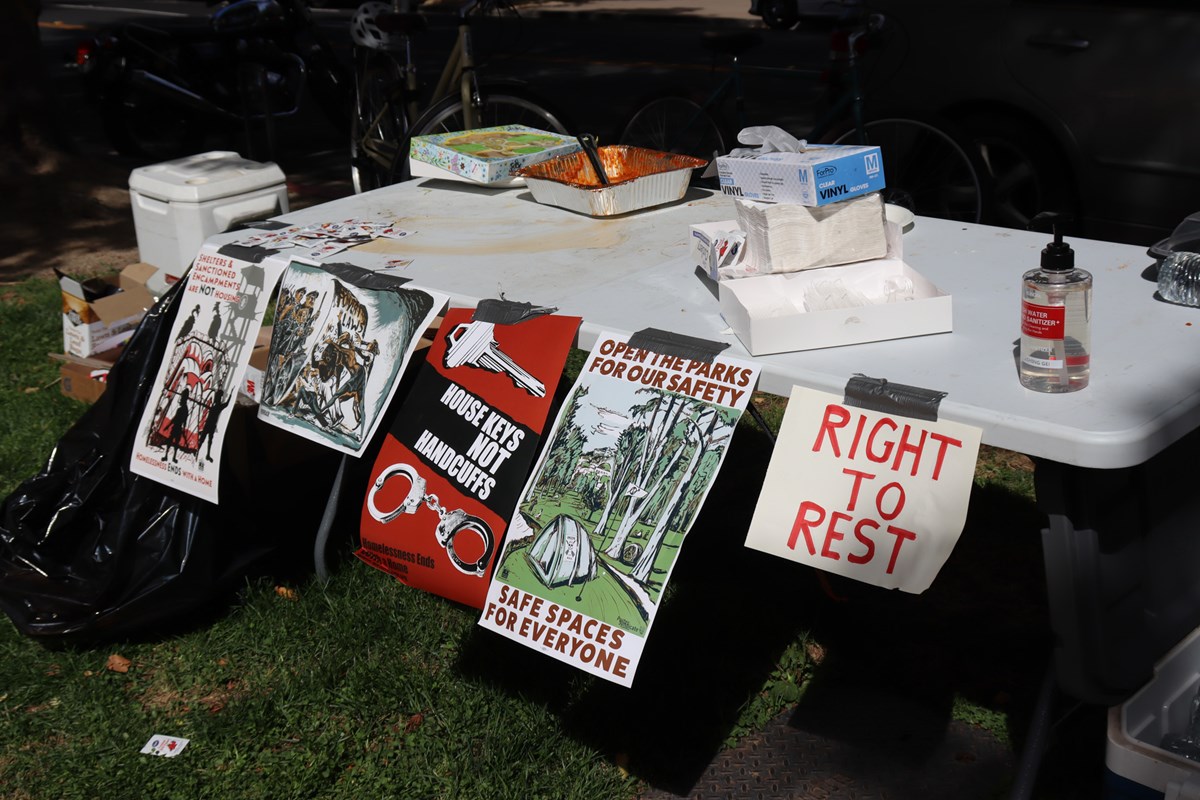 Protest signs cover a table outside Sacramento City Hall during a rally on Tuesday, July 29, 2025. Advocates and unhoused residents gathered ahead of the City Council vote on a camping ban.CapRadio/Tony Rodriguez
"I don't think the mayor is being honest in his account of enforcement," Hockbaum said. "Since his mayoral term has started, fines and arrests have increased sixfold, and there has been no increase in shelter capacity or affordable housing throughout the city."
Dr. Flojaune Cofer, a public health advocate who narrowly lost the 2024 mayoral race to McCarty, told the council the policy went against promises they made on their campaign trails.
Cofer said the majority of the council does not interact enough with unhoused people to understand the impact of this ordinance.
"We would not allow a panel full of men to make decisions for women. We would not allow a panel full of white people to make decisions for people of color," she said. "We would want the people who are impacted to be involved, but it seems like homelessness is the one area where it's totally fine to make decisions without consulting anybody with lived experience."
The runner-up in the mayoral race pointed out how they ran their campaigns before they were elected.
"None of you promised us that you were going to sweep people away from the place they are, with nowhere to go," Cofer said.
Karina Talamantes, the District 3 councilmember who voted for the ban, said the ordinance doesn’t solve homelessness but reflects workplace safety concerns.
"I’m not pretending that this ordinance solves homelessness or even improves it. It doesn't," she said. "But we are an employer of nearly 6,000 people who also deserve to feel safe at the workplace."
Follow us for more stories like this
CapRadio provides a trusted source of news because of you. As a nonprofit organization, donations from people like you sustain the journalism that allows us to discover stories that are important to our audience. If you believe in what we do and support our mission, please donate today.
Donate Today