Editor's note: We’re only using students’ and guardians’ middle names because they’re minors and this story discusses their disabilities.
Kamilah, a Sacramento high school junior, sits on his bed in a room adorned with SpongeBob SquarePants posters as SZA’s “Saturn” plays in the background. For Kamilah, who has ADHD, music helps him stay focused — a constant challenge, especially in school.
“It’s easier to concentrate when I have music in my ear,” said Kamilah. “But some teachers send their students to the principal’s office for that.”
This is just one of the many accommodations that are being neglected at Kamilah’s school. He has an Individualized Education Program, or an IEP, which is a document that outlines the services a school is legally required to provide for students with disabilities.
Kamilah’s IEP promises several key supports: Extended test time, therapy, and a one-on-one aide. However, those services have not fully materialized, leaving Kamilah and their family frustrated. And at times, Kamilah finds himself being disciplined for behavior issues that are directly linked to his disability.
The Black Parallel School Board is a community-based nonprofit founded in 2008 to address systemic inequities affecting Black students in Sacramento. They help families like Kamilah’s navigate school system bureaucracy.
Their efforts received statewide attention in 2019 when the organization sued the Sacramento City Unified School District, alleging that Black students with disabilities were being disproportionately segregated and disciplined. By 2024, a settlement led the district to agree to an improvement plan that outlines how the district would be “more inclusive and less punitive.”
Statewide data underscores the urgency of their work: While Black students make up about 5% of California’s public school population, they are disproportionately represented in special education programs and over-disciplined. And in Sacramento, a 2021-22 report by the California Department of Education cited Sacramento City Unified and San Juan Unified school districts for their extreme disciplining of Black students.
Often conflated, the compounded result for students is segregation from general education classrooms, denial of the documented benefits of inclusive learning environments and more effective instruction.
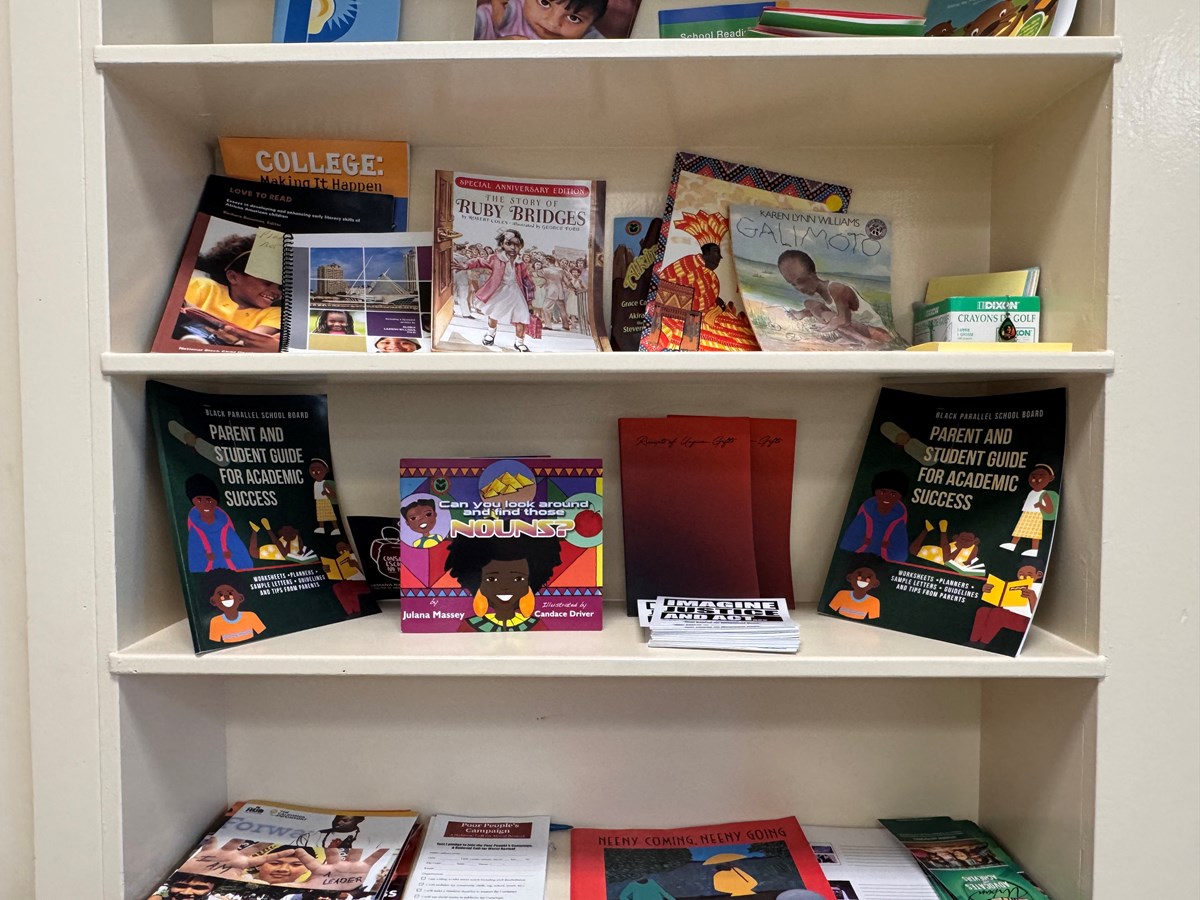 Children's books featuring Black stories are available for families who need them at the Black Parallel School Board's office in South Sacramento.Srishti Prabha/CapRadio
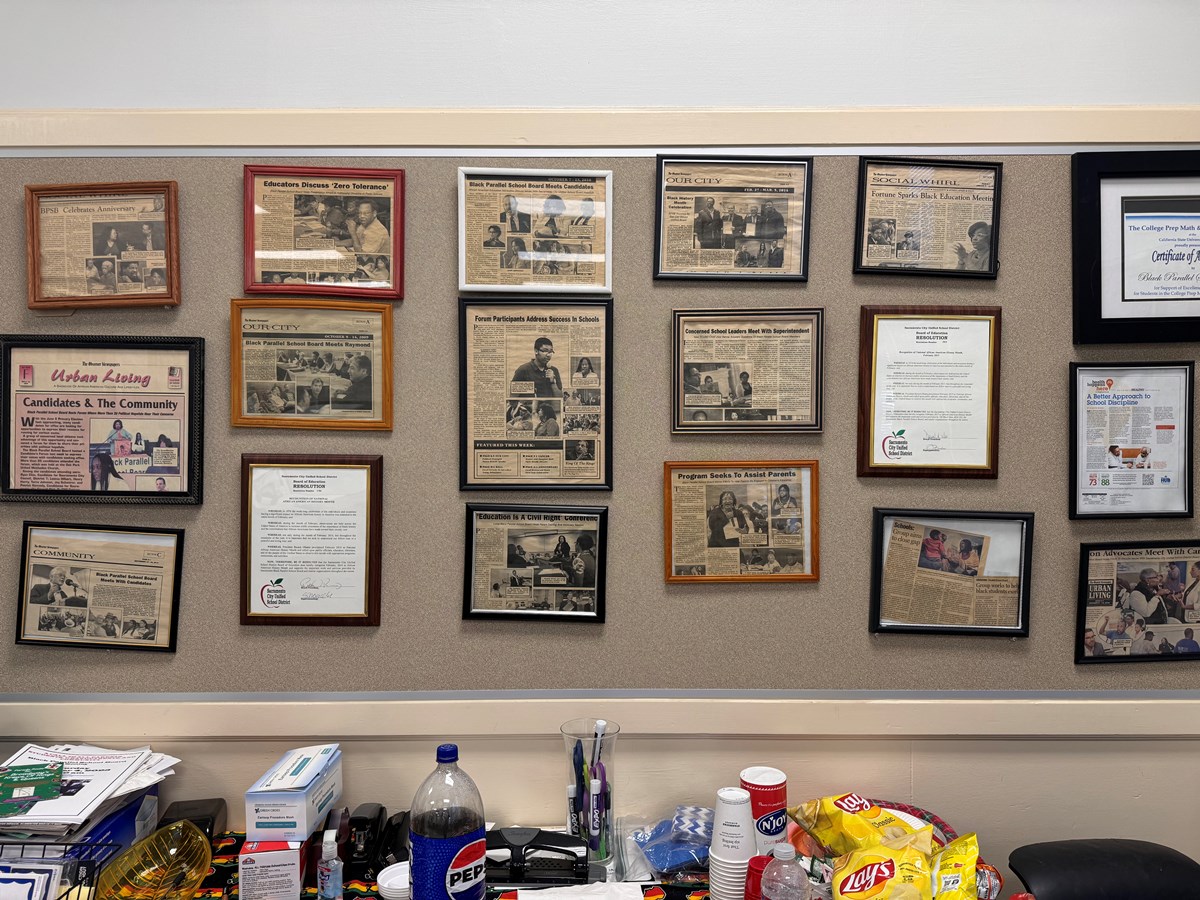 News clipping covering the Black Parallel School Board's work over the years at their headquarters.Srishti Prabha/CapRadio
‘Unteachable’
On an October afternoon, Kamilah and his grandmother met with Marian Bryson, an advocate from the Black Parallel School Board. The group huddled around the dining table.
“We’re getting ready to do a follow-up,” said Bryson, “And I wanted to see if you had any concerns or issues you want to bring up at the scheduled IEP meeting.”
For Kamilah, the absence of the promised one-on-one aide has been a significant hurdle.
“Someone making sure I don’t miss out on any work, helping me do the work, at least sitting next to me half the time,” Kamilah said, describing how the aide could be of assistance.
Bryson was resolute: “Let’s demand that they implement the IEP with all [his] full services and with [his] one-on-one aide,” she said.
When asked for comment, Kamilah’s school district declined to respond.
Kamilah, his grandmother and Bryson all report that the school’s special education administrators have deemed Kamilah “unteachable” and have placed Kamilah on a certificate of completion track “which could be a special day class.”
To which Kamilah quietly replied after a long pause, “I’m not that special.”
For Black Parallel School Board employees, Kamilah’s story is familiar.
Carl Pinkston helped found the organization after hearing numerous Black parents express feeling side-lined at local school board meetings.
They told him: “One, I am only given two minutes to speak. Two, the board members don't look at me. Three, they don't even follow up.”
Darryl White, chair of the board, was deeply affected by the testimonials of families dealing with special education.
“You're talking about terrible experiences again and again and again,” he said. “And we knew then that we were gonna turn this scenario around.”
White explained the need for an organization focused on Black student needs.
“Disproportionality is a keyword and segregation is another,” White said. “It is thought by the system that we need to be punished, segregated … because we’re unruly.”
The organization’s initiatives are an ever-expanding list: Offering IEP training, hosting special education clinics, organizing equity walks, and engaging in regular dialogues with school district leaders.
‘A healthy dialogue’
Jim Peterson, the principal of Luther Burbank High School in South Sacramento, is one of several school leaders who have welcomed the Black Parallel School Board’s involvement. He meets quarterly with the organization to review data on student outcomes and discuss possible interventions.
“It’s a very healthy dialogue to sit down and think about what the data is telling you — who is passing, who is not, who is getting suspended more, who is getting suspended less,” Peterson said.
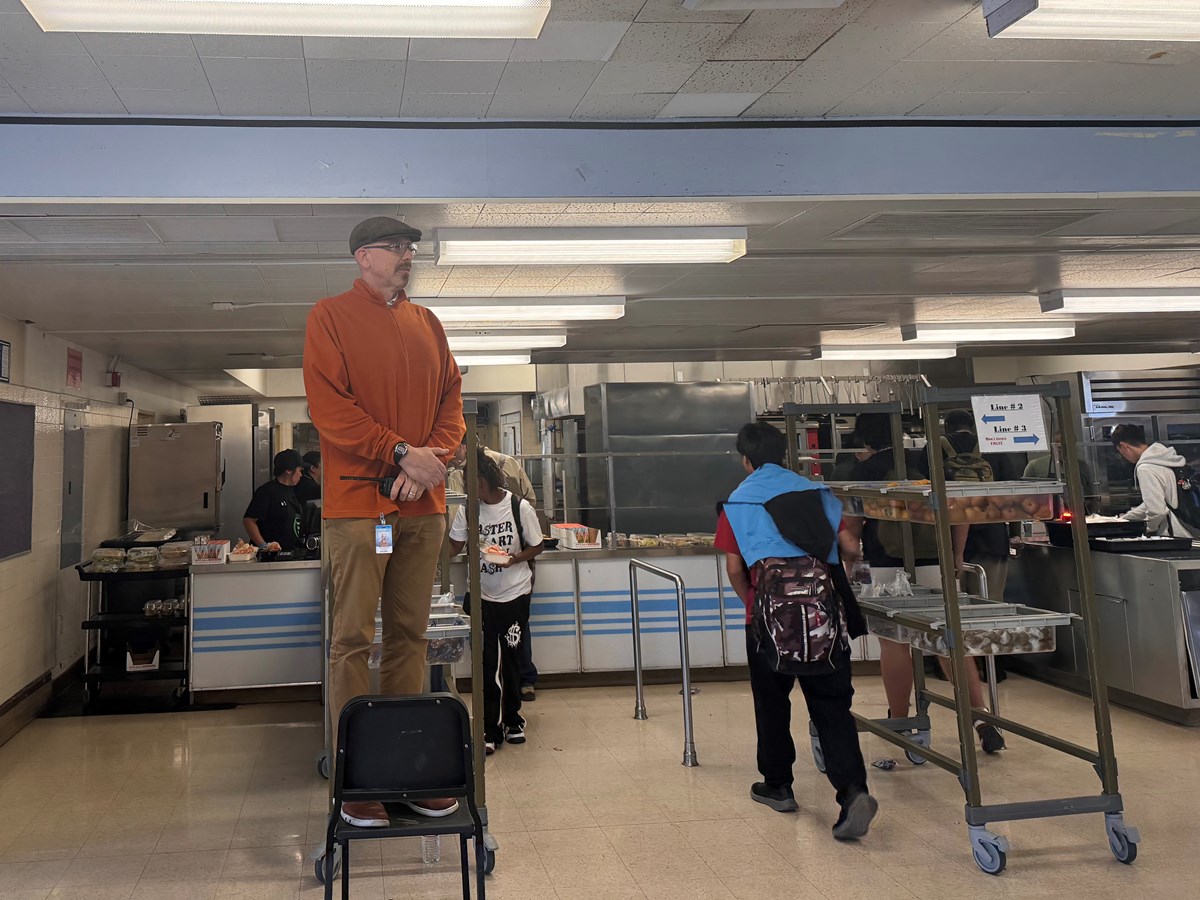 Principal Jim Peterson overseeing lunch at Luther Burbank High School.Srishti Prabha/CapRadio
Belinda Kirk, Assistant Principal at Luther Burbank High, is responsible for the special education department and works closely with board advocate Bryson.
“Having her as an advocate representing Black Parallel School Board has been probably one of the biggest assets for us as a school site,” said Kirk. “I want our parents to understand what an IEP is and she's helped bridge that gap.”
At Luther Burbank, those interventions have transformed outcomes for students like Tariq, a soft-spoken sophomore with autism who struggles to express himself.
“I felt like I couldn’t do anything as much as other people could – I felt restricted,” he said about his previous schooling.
His mother, Maiilik, said those responsible for Tariq’s education before high school had also deemed him “unteachable.” She frantically explored every possible avenue to advocate for her son.
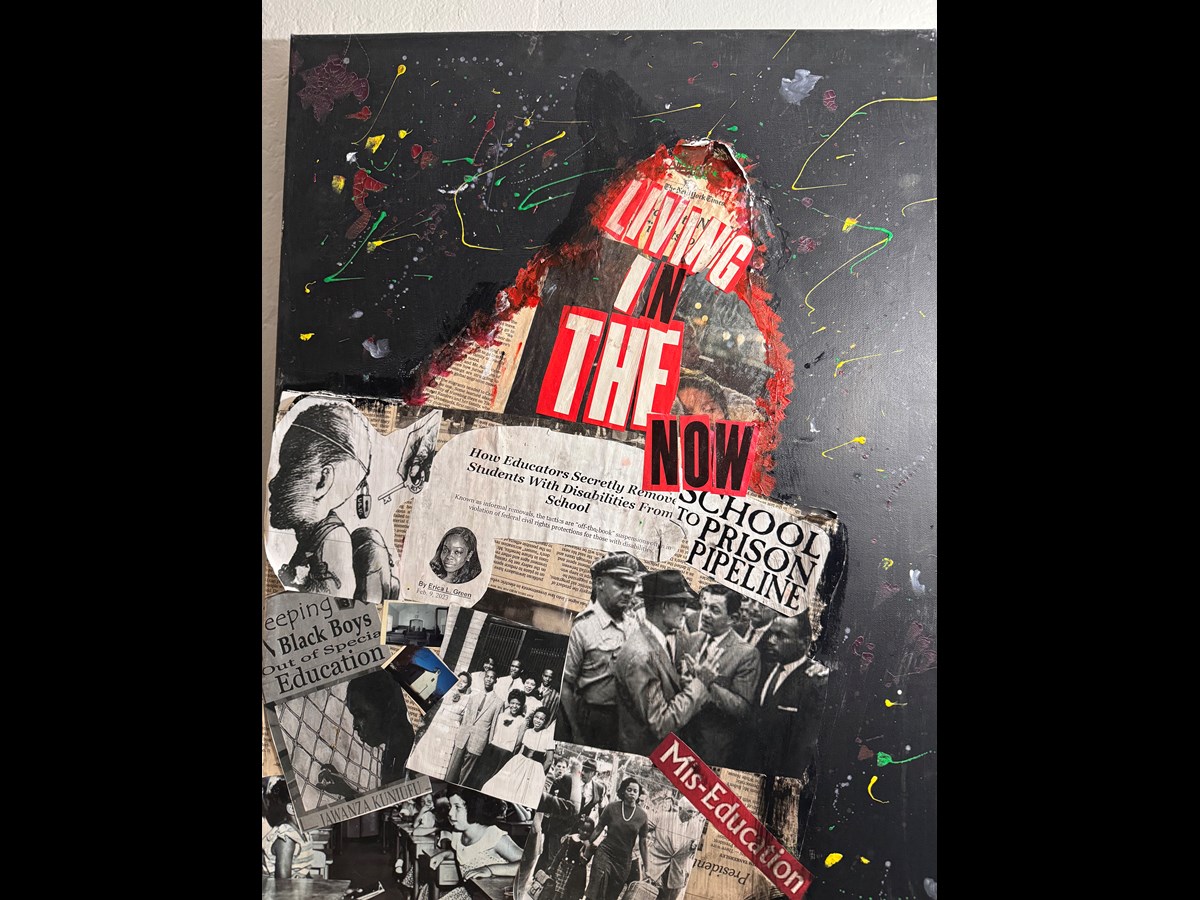 Artwork made by Tariq, labeled ‘The miseducation of an Autistic Black boy.’Srishti Prabha/CapRadio
“Even though I knew my son’s rights, my rights as a parent and what he needed to succeed, it always felt like a fight,” she said. “I felt unsupported.”
It wasn’t until Maiilik connected with the Black Parallel School Board that she said she finally felt relief. The Black Parallel School Board recommended that Tariq attend Peterson's school, and Bryson began attending his IEP meetings.
“More teachers care about my grades and check up on me,” Tariq said. “That wasn’t happening in middle school.”
Maiilik encouraged her son to brag a little, and asked him to share his GPA.
“My GPA is 3.8 now,” said Tariq. “I felt proud of myself when I saw that.”
For families like Tariq’s and Kamilah’s, the organization represents more than advocacy — it is a lifeline in navigating a system that often feels opaque and adversarial. The Black Parallel School Board is mobilizing parents across California and according to them, families in five other districts have begun forming their own parallel school boards.
Follow us for more stories like this
CapRadio provides a trusted source of news because of you. As a nonprofit organization, donations from people like you sustain the journalism that allows us to discover stories that are important to our audience. If you believe in what we do and support our mission, please donate today.
Donate Today