The Central Valley is growing, projected to add millions of people over the next few decades.
But many of these communities have faced a chronic shortage of doctors and other essential medical care. And for a long time, there was no local school in the region to train the next generation of medical specialists.
Last week University of the Pacific announced historic plans to open a new school of medicine in Stockton, with hopes of welcoming the first group of students by the end of the decade.
The new school is described as being the first M.D.-granting institution outside of the Bay Area, Southern California and the Sacramento region, specifically targeting the critical shortages in the Central Valley.
Pacific President Christopher Callahan and Assemblymember Rhodesia Ransom spoke with Insight Host Vicki Gonzalez about the university’s plans to get this new school off the ground.
This interview has been edited for length and clarity.
Interview highlights
When did conversations start about breaking ground on a medical school?
CALLAHAN: Everybody talked about it, the great need for a medical school in the Central Valley, for years and years. All sorts of different universities and Pacific was no exception. We started really getting serious about 14 months ago. We're in a really strong financial situation now at the university, we have all these great strengths in healthcare and our communities need this so desperately — let's get serious.
We hired a consulting firm and we started looking at the nitty-gritty of this. What would it take to create an M.D.-granting university for the Central Valley, in the Central Valley? It's very complex, there's a reason why universities don't start these up right away. It's about a five-year process with accreditation and the like. But we came to the conclusion: not only do we have the ability to do this, but I think we have the responsibility and the moral obligation to do this considering who we are as leaders in higher education, and the importance of Pacific to the Central Valley and vice versa.
Do you already offer healthcare programs at Pacific?
CALLAHAN: Yes, we do. We have our School of Health Sciences which is based in Sacramento, but also with campuses in San Francisco and Stockton. Those are the allied health professions, things like nursing, physician assistance programs, occupational therapy, physical therapy, audiology, and our newest one — midwifery.
We've had for many years now a world-class school of dentistry, the Arthur A. Dugoni School of Dentistry in San Francisco. And on the Stockton campus, the Thomas J. Long School of Pharmacy. We have all of this great expertise in the healthcare space, and when we actually open our school of medicine – we hope in fall of 2030 — we'd be one of only 36 universities in the United States that has all four of those schools.
Assemblymember Ransom, your district is in San Joaquin County and includes communities like Stockton, Tracy and Mountain House. There’s a doctor shortage across the Central Valley overall. How big of a concern is this for you as a lawmaker?
RANSOM: This is a huge concern that we talk about a lot in the state legislature. Families are already filling the doctor shortage, there's already a problem with access to care. When you think about access to care, it's important to understand all the things that go into that [including] the doctors. The fact that we don't have a local pipeline of doctors ready to go, when we know that there's going to be an exodus of doctors who are going to be retiring very shortly, is very concerning. We need to make sure that we have doctors who are trained in our communities, who understand the community.
We also know historically that when you train the doctors in the community, that they will stay more likely in the community. We know that 60% of the doctors who train here locally will stay, and if they've gotten their post-graduate before they go to medical school, we're looking at about 80% of them staying. That is something that we really need to do: create an infrastructure and create an environment where we can start solving the problems with access to care, and it starts with the medical professionals.
What are the main concerns among your constituents when it comes to the critical needs for medical care?
RANSOM: In the Central Valley general access is really important, but also the women's health care, OBGYNs. They are leaving the region, and that’s why when Pacific started the midwifery program we were so excited about that because we really need to ensure that women are not traveling an hour to give birth, and to have those critical appointments.
The pediatrician services are very critical. You see people asking where they can get a pediatrician without having to travel out of town. That's just not a way to have a healthy community, and we have to increase the [number of] doctors to take care of these people.
Will there be any state funding tied to this medical school?
RANSOM: I'm honored to lead that and to really connect the dots. I had quite a few of the colleagues that I have in the state legislature sign on, and agree with me that it's important that we have another medical school in California, and more importantly in the Central Valley, because the Central Valley will also feed the medical professionals in the Bay area as well as further down south. So we had a number of folks come on board; we’ve met with the health chair, we’ve met with the budget chairs. We’re starting those conversations with the governor's office as well, because we have to really do everything to support the school's efforts.
I appreciate that Pacific, unlike some other schools, has been able to say, "we already have skin in the game." I met with President Callahan a little less than a year ago; he already had a feasibility report ready to go. He'd already shown us where they were lining up philanthropic dollars. But if we can connect those dots for the state on how this would help us, to be able to answer the question about access to care, I think we'd be much better for it.
The state is in a difficult financial situation, and potentially for fiscal years to come. Is that a concern for you as this school looks to break ground?
RANSOM: We were able to show a balanced budget, and part of what you see in these budget proposals is that we're backfilling for all of the cuts for H.R.1. I'd like to remind people that the environment that we're in right now is not going to last, and we still need to continue to solve our problems.
When you have a partner like Pacific, which is a private university but is in partnership with our local community colleges and very much in partnership with state and local government, we really want to be able to not let this opportunity pass us by. That is the message that I am getting across to our colleagues; really showing how if we don't invest in healthcare and doctors and, specifically in a medical school, we're going to be in even deeper trouble in a few years.
How much does starting a medical school cost? How much money does Pacific need?
CALLAHAN: In order to do it the way we want to do it, to have a fully financially self-sustainable school of medicine, the answer is we need $150 million of one-time money. That would pay for new construction of a 100,000 square-foot state-of-the-art medical complex, for all the expensive equipment that you need to go in there, and to cover operating costs for that first decade until it becomes financially self-sustaining.
We're confident with Assemblymember Ransom's help, with Congressman Harder's help on Capitol Hill, we've already had some significant philanthropic gifts come in, that we'll be able to reach that goal in short order.
What would the education experience look like at this new school?
CALLAHAN: I will start off with: what kinds of students will be there? Pacific is different in a lot of different ways from a typical private school in who we serve. If you look at our undergraduate population, which is where we hope in a pre-med program they would be flowing directly into our school of medicine, this is an atypical student population. The majority of our students come from the Central Valley. Half of our undergraduate students are from first generation families, and 41% are receiving Pell Grants, which [are] for lower socio-economic families. That's very very unusual; that is the sort of population that you would see more typically in state-funded universities. I think that’s important because we don't just want highly qualified undergraduates to come into this medical school. We want them from our communities. They are more likely to stay and practice if they study and do their clinical rotations and residencies here.
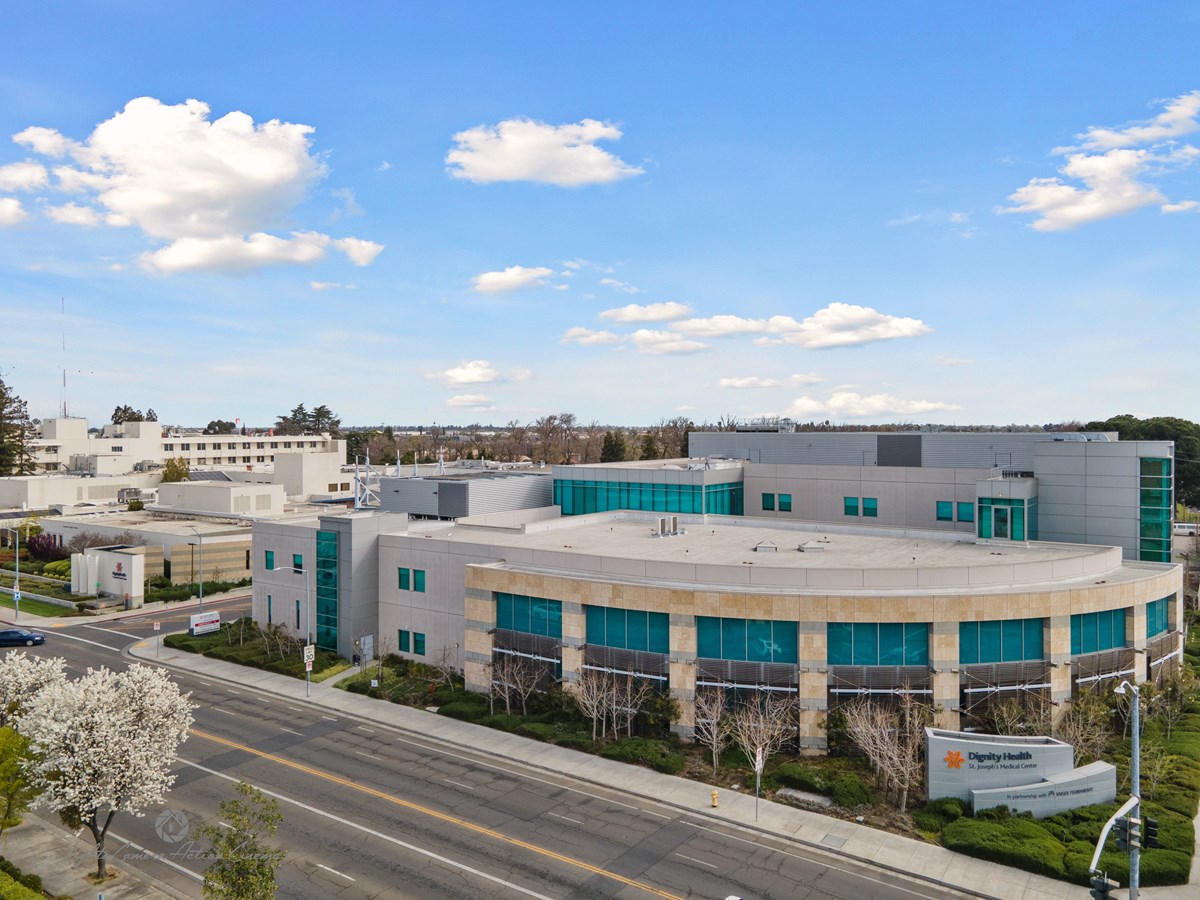 Dignity Health's St. Joseph Medical Center in Stockton.Courtesy of University of the Pacific
It'll be a four-year program; the first two years are in our classrooms and labs in this new building. And then years three and four are in clinical rotations. We already have a strategic clinical partnership with Dignity Health St. Joseph's Medical Center. That’s enormous because one of the challenges of starting up a medical school is finding those clinical placements and eventually the residency placements.
With the goal of having a class by 2030, what are the other big challenges that you’re working to overcome?
CALLAHAN: It's really that accreditation process which starts right away. One quick example of how far in advance this needs to be done. In our hopes to open in fall of 2030, we need a founding dean. We're starting the national search for a founding dean next week; that’s more than four years in advance. Those are the sorts of things that we want to make sure we're tracking with our accreditation milestones. It’s something we’re hyper-focused on.