Davis voters on Election Day will decide if one of the largest housing projects in the city’s history can move forward.
If it passes, Measure V would reshape the agricultural northern edge of Davis, a community that has historically curbed new development outside its urban boundary lines. The measure would authorize the construction of Village Farms Davis, an 1,800-unit residential development spanning 498 acres with a 15-year build out.
The proposal has sparked a contentious campaign between supporters and opponents. Supporters say Village Farms will provide a much-needed boost to the city’s housing supply and help reverse its declining school enrollment. Critics, meanwhile, say the large development will cause traffic gridlock and strain the city’s resources while jeopardizing environmental safety.
Project developers North Davis Land Company also plan to donate 16 acres of land and $6 million towards affordable housing, designed to ensure high competitiveness for state tax credits for non-profit developers.
The community would also include several parks, bike trails, and land dedicated towards habitat conservation, according to the development plans.
In addition, land will be dedicated to Davis Joint Unified School District (DJUSD) intended for pre-K facilities and an educational farm.
Under the city’s Measure J/R/D ordinance, originally passed in 2000, any development which impacts agricultural preservation and the “provision of an adequate supply of housing” must be approved by voters. 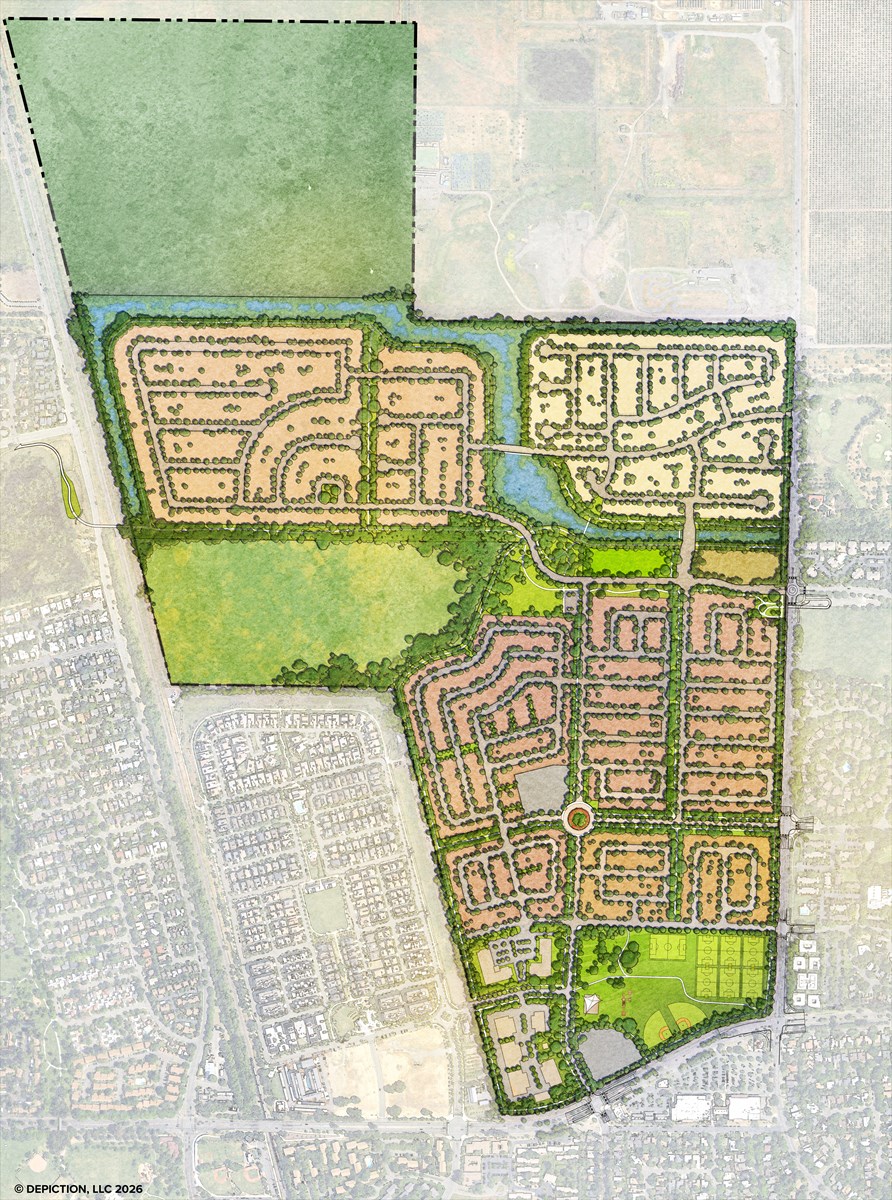 A rendering of Village Farms Davis.Courtesy of North Davis Land Company
The "Missing Middle" and school enrollment
At the heart of the debate is how much the development could alter the small-town nature associated with the city of Davis.
Proponents of Village Farms argue the project could bring in a younger generation of families. That, in turn, could help the overall financial health of the Davis school district, which has seen a drop in enrollment over the years.
In November, school district officials said enrollment had declined by 300 since 2019 with the district projecting a loss of around 1,000 students over the next decade.
Some think Village Farms may be one solution. The district estimates the new community could add 1,100 new students over time.
Lois Wolk, who served two terms as mayor of Davis in the 1990s and is a former California State Senator, told the Davis City Council in January the development was “long overdue.” Wolk said while UC Davis continues to “dramatically” expand, the city has yet to respond to make room for new home and business owners.
“Our schools’ problems reflect that very missing generation,” Wolk told the council.
Changing Davis’ small town nature
Opponents say the project is too big and that market home prices will be far too high to benefit the local workforce. They point to a fiscal study conducted by BAE Urban Economics.
Eileen Samitz, a representative for the No on Measure V campaign and former Davis Planning Commissioner, estimated the average home prices could range from $740,000 to $1.2 million, which she said is not the “affordable” housing promised.
"That means a $6,000 to $9,000 plus per month house payment once you cover the mortgage, property taxes, and insurance," Samitz said. "Young families cannot afford that huge monthly payment. Village Farms will not bring in hundreds of kids as the school district would like to believe.”
Sandy Whitcombe, a project manager for Village Farms Davis, disputes those figures, pointing out that those prices only represented an average for a specific tier of mid-density housing.
“Our market rate housing is attainable by design. That's the crux of our whole concept," Whitcombe said. "Over 1,000 of the lots are required to be under 5,000 square feet, but they are, in fact, much smaller than that. Attached homes will start in the $400,0000 [range] and small single-family homes will start in the $500,000 [range]"
Independent housing analyst and appraiser Ryan Lundquist said Davis remains a high-barrier market. “This year, when you look at every single sale [in Davis], the average price is about $950,000. It's definitely a higher price point," Lundquist said. “A lot of people would appreciate more of an entry-level product. That's going to resonate with some.”
While it's difficult to predict what the housing market will be years from now, Lundquist said it's “hard to imagine” these smaller units would leap to over $1 million.
The Affordable Housing Plan
The housing plan for Village Farms designates 20% of the project, or 360 units, for affordable housing. However, some are wary of the fine print.
Samitz called the affordable housing initiative "more of a scam than a plan," pointing to a clause in the development agreement regarding a final-phase 100-unit apartment fallback.
"The word is ‘may’, not ‘shall.’ The city ‘may’ build 100 affordable apartments in the very last phase," Samitz said. "The developer could simply walk away from building these affordable apartments…there's nothing binding about it at all. It could be completely renegotiated."
Whitcombe strongly pushed back on this interpretation. She emphasized that the clause was added towards the end of the process by the city council as a “worst-case scenario.” Instead, she argued the core plan relies on an unprecedented donation of land and capital.
"We're donating 16 acres of land, which is by far the largest land dedication ever for affordable housing in the city," Whitcombe said. "We are also donating an unprecedented $6 million to help meet the financing stack towards construction... Affordable housing non-profits are going to be salivating for this opportunity. Absolutely salivating."
Traffic Gridlock and Financial Liability
The "No on Measure V" campaign projects severe quality-of-life impacts.
The development is estimated to bring 15,000 new daily car trips onto local roadways according to the 5,000 page Environmental Impact Report (EIR).
Samitz believes that this number might be an understatement because the EIR relies on what she says is an unrealistic set of transit expectations.
"The EIR assumes that a significant number of residents would be using public transit, walking, and biking daily, which is just unrealistic," Samitz said. "They're claiming to bring families, but families rely on cars to bring kids to and from. Davis doesn't even have a school bus system."
Samitz notes that under the current development agreement, the city could find itself on the hook for major infrastructure costs, saying the developer can be reimbursed for up to 97% of the costs for two promised grade-separated transit crossings.
Whitcombe completely rejects fears of traffic impact and the financial critique, stating that the project’s infrastructure improvements are structured as mandatory baseline features funded entirely by the development.
"The project funds tens of millions of dollars in upgrades at every intersection adjoining the project," Whitcombe said. "If you read the EIR, it actually concludes that each corridor peak hour flow will be at acceptable levels after we put in the improvements... There's no taxpayer burden, not a dollar."
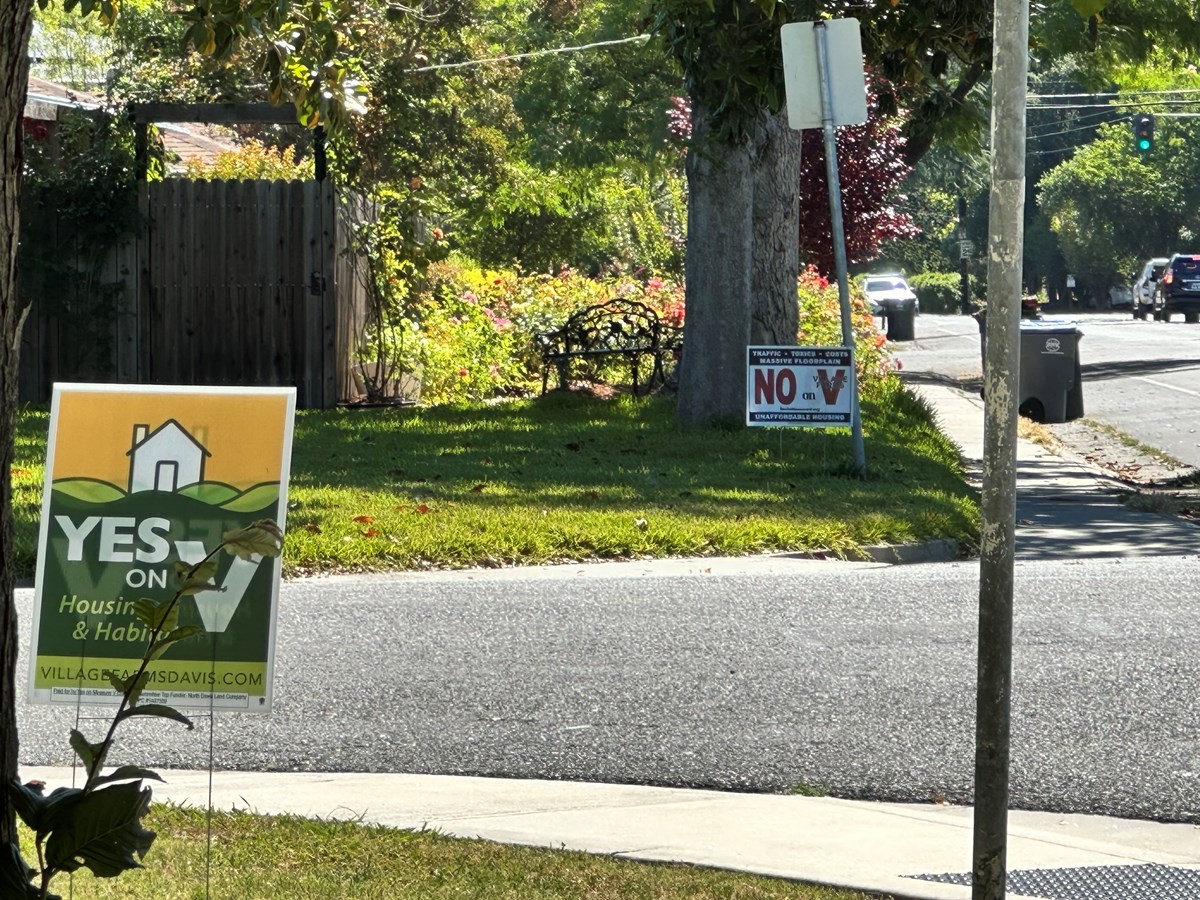 'No on V' and 'Yes on V' signs stand near each other in Davis. June 1, 2026.Courtesy of Debra Cannon
Environmental Integrity
The physical site of the proposed development presents its own set of critical debates. The northern edge sits next to an unlined, 50-year-old municipal landfill and a sewage treatment plant. Recent monitoring wells also detected the presence of forever chemicals in the local groundwater known as PFAS.
Samitz warns that construction on the property will dangerously interact with this shallow groundwater, which has been measured as close as 6 to 9 feet from the surface.
"They're going to reroute Channel A, the main drainage system of North Davis, into a convoluted circle that looks like a moat around two neighborhoods, digging down 9 to 10 feet," Samitz said. "The contaminated groundwater will communicate with the channel runoff, continuously feeding these contaminants through the adjacent Wildhorse neighborhood, the Yolo Basin, and eventually into the Sacramento River."
Whitcombe points to the EIR which studied the site and proved that historical organic landfill contamination has completely dissipated. She emphasized that the deep PFAS groundwater will remain entirely isolated from residents.
"The groundwater where this PFAS is found is 30 feet below the surface on average and it will never be touched," Whitcombe said. "It's not used for irrigation or drinking. All water at Village Farms will be City of Davis municipal water... The state regulatory authority formally stated that the groundwater at the site poses no risk to future residents."
Two Divergent Paths for Davis
Recent data from the California Department of Finance has shown cities around the Sacramento region are among the fastest growing in the state.
"Sacramento, Roseville, Elk Grove, and Folsom are all making the list in terms of most units added. But you have a city like Davis that's not making that list," Lundquist said.
Lundquist said residents and the city council will have to decide what the city will look like if families can't afford to live in Davis.
“It's just going to be engineers, architects and professors and doctors. I think that's problematic,” Lundquist said. “If you have more units then you can have more people there and more units tends to help with affordability.”
For Whitcombe and proponents of Measure V, rejecting the development means accepting gradual decay.
"This starvation of new housing for over 20 years is not making things better," Whitcombe said. "We want Davis to thrive. We don't want Davis to turn into a retirement community that is slowly dying.”
For Samitz and the No on V campaign, the goal is not to stop growth, but to stop what they view as a flawed, fast-tracked plan in favor of superior alternatives like the upcoming Willow Grove, Palomino Place, and Bretton Woods projects.
"We want good planning. We reject bad planning," Samitz said. "Village Farms is the problem, not the solution."
Follow us for more stories like this
CapRadio provides a trusted source of news because of you. As a nonprofit organization, donations from people like you sustain the journalism that allows us to discover stories that are important to our audience. If you believe in what we do and support our mission, please donate today.
Donate Today