For decades, a facility in the North State has been working to help bring closure to loved ones by analyzing unidentified human remains.
Chico State’s Human Identification Lab (HIL) was established in the 1970s and its work has taken the lab’s small team of experts into the heart of natural disasters, including the 2018 Camp Fire, as well as to the battlefields of World War II.
Recently, the HIL’s researchers worked with the U.S. Department of Defense to uncover the remains of 19-year-old U.S. Army Air Forces Staff Sgt. Stephen J. Fatur, a tail gunner aboard a B-17G Flying Fortress that crashed in Poland in March 1945. Fatur’s remains were eventually accounted for by Defense Department personnel in July 2025.
Dr. Ashley Kendell is the director of the HIL, and Dr. Colleen Milligan is one of its forensic anthropologists. They spoke with Insight Host Vicki Gonzalez about the lab’s work, and traveling abroad to help solve long-lasting mysteries.
This interview has been edited for length and clarity.
Interview highlights
Why was the Human Identification Lab started?
KENDELL: The Chico identification lab has been around for a little over 50 years. The program itself [was] started by Dr. Turhon Murad in the 1970s. We had a really, really small caseload; we would receive maybe one to 10 cases per year. And over the last 50 years, our casework has grown exponentially. We now receive around 120 to 150 cases per year that cover about 90% of the counties in California.
A lot of that is attributed to the fact that of the forensic anthropologists that are in the lab. Four of us are POST-certified [Peace Officers Standards and Training], and we teach all of the new detectives throughout the state of California in a homicide investigation course how to utilize forensic anthropological services, and what we can do as far as forensic archaeological excavation in homicide investigations.
Is this lab unique to California or the West Coast?
MILLIGAN: This is a lab that is largely unique to the West Coast. There are labs like ours across the country. You have ones that are large at the University of Tennessee; they're well known for what we say is the “body farm.” You also have labs in the Midwest as well as Texas. Chico State’s Human Identification Lab is the largest forensic anthropology lab at a university west of the Rockies. Part of the reason we serve as much of the state as we do is because of the number of professionals that we have associated with our lab.
What kind of large-scale responses have you been involved in?
MILLIGAN: Personally, on my end, most of our last two decades of work have been related to California's wildfires. We respond to wildfires across the state, as well as responding in 2023 in Maui for the wildfire there. What we do with these responses is assist the recovery and the identification of human remains and victims from these large-scale events.
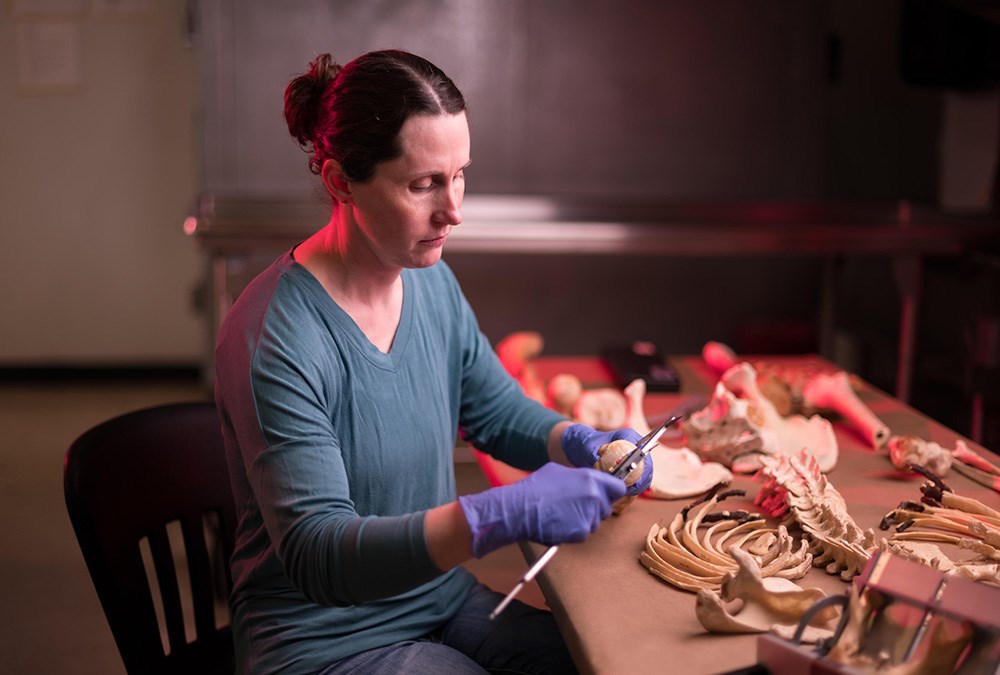 Dr. Colleen Milligan is one of the forensic anthropologists at Chico State's Human Identification Lab.Courtesy of Chico State
In my background — all of us have previous experience with sort of mass fatality events mindset — mine started in graduate school as I was on a fellowship with the Department of Homeland Security working on mass fatality policy development. That included looking at some of the later stages of Hurricane Katrina in Louisiana at that time.
KENDELL: My first response was the 2018 California Camp Fire. I had just started at Chico State in 2017 so prior to that, I hadn't had any mass fatality response in my past. I've learned a lot over the last 10 years, and unfortunately on an almost annual basis now our lab is employed to do mass fatality response for fires.
What goes into processing a case?
KENDELL: So depending on the types of cases we get, we focus on cases [where] we can get information from the human skeleton. We often interface with sheriff corner's offices, medical examiners' offices, and [the] main focus in our lab predominantly comes from helping to make identifications on remains that are not visually identifiable.
We also get a lot of requests for trauma analysis, so helping the forensic pathologist or the sheriff corner make determinations as to cause and manner of death based on interpretations in the bone of things like sharp force trauma, projectile trauma or blunt force injuries.
I would imagine the time frame to identify remains can vary greatly depending on the circumstances.
KENDELL: It does. Our timeframe [really depends] on the type of case. We sometimes look at a single skeletal element and we are tasked with, what is it? Is it human, is it non-human? We can do those types of cases very quickly. However, if we do get more complicated cases that are fragmentary, or are burned as are the case with the wildfire decedents, those cases can oftentimes span a couple of weeks in order to process and then do a full analysis for that case.
Some recent work involved identifying servicemembers killed in World War II alongside the Department of Defense. How did you get connected with the federal government?
MILLIGAN: One of the major employers for our field in the U.S. is actually the Department of Defense. If there are 200 or so forensic anthropologists across the U.S. about half of those are employed by the Department of Defense. They run two very large labs — one in Honolulu, Hawaii and one in Omaha, Nebraska — for identification of servicemembers killed in foreign wars in particular.
There are so many service personnel that are still unaccounted for, that even with having that many of us employed by a single entity, that workload requires a much larger cooperation with agencies and universities to help locate and ultimately [hopefully] recover those that are unaccounted for. That's where we came in.
One of those operations involved recovering an airman’s remains from Poland. How does working on a case like this, from decades ago, complicate your work?
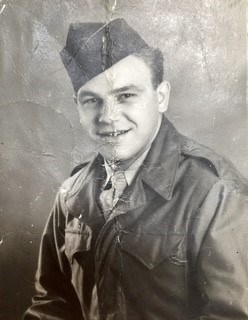 U.S. Army Air Forces Staff Sgt. Stephen J. Fatur died in March 1945 after his bomber went down over Poland. His remains were eventually recovered with the assistance of experts from the Chico State Human Identification Lab.Courtesy of Defense POW/MIA Accounting Agency
MILLIGAN: Something that is from World War II, because of how much time has passed between the event itself and when recovery operations are able to be initiated for various reasons, that really complicates the recovery picture that you're looking at. Not only do you have an event like a plane crash which may fragment [the] remains, make it more difficult to recover in the first place, but then you have time that passes. Areas develop, they change, you have different activities that occur in the same location, all of which makes it not only more difficult to find, but also recover.
Who ultimately does the identification?
MILLIGAN: In a case like this, different from what we would do with our normal casework, our role is simply to assist on the field recovery side of this particular operation. Forensic anthropologists at the Department of Defense's labs will be the ones that are responsible for the actual identification of recovered service personnel.
What does this fieldwork look like?
MILLIGAN: We traveled to Poland in August 2019 and in an operation like this, what you're looking at for our purposes is really a large area where it's been identified that this is the last known location for a downed plane during World War II.
For us it is about excavating this using archaeological techniques to look at what is really going to be evidence of both the plane and potentially missing service personnel in subsurface contexts — things that would be buried through time.
This is intense, emotional work. How do you process or compartmentalize it?
KENDELL: I think for a lot of us that compartmentalization is just such an important facet of what we do. A lot of what we see are homicide cases, but they're always decedents that have families and loved ones. For me it's really important to keep the focus on what we're doing and the skill set that we have, and what we can offer to the loved ones that remain. It helps me compartmentalize and just keep my mind on what I'm trying to do and what the end goal is, rather than what potentially happened to a decedent.
MILLIGAN: Most of the time when we're in the field or when we're operating on a case, you're focused on the task at hand. You have a very real way to assist both victims and their families through what your investigation can find. In that moment, your focus is your job.
I think for most professionals that work in any kind of context like this, especially in death investigation, what you think of how you connect to your community, about victims and their families, maybe comes later after your work is complete.
Follow us for more stories like this
CapRadio provides a trusted source of news because of you. As a nonprofit organization, donations from people like you sustain the journalism that allows us to discover stories that are important to our audience. If you believe in what we do and support our mission, please donate today.
Donate Today