 Each month, writer and journalist Chris Bowman offers up his unique take on the latest books about environment and energy issues in California and beyond.
MARCH 2014
Junkyard Planet: Travels in a Billion-Dollar Trash Trade
by Adam Minter
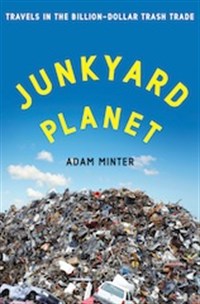
Most Americans’ concept of recycling begins and ends at the curb. “Junkyard Planet”picks up the story from there.
The new book takes us on an eye-opening international journey of junk with a first-class guide.
The author, Adam Minter, is both a child of the scrap industry – his parents ran a small junkyard in Minnesota – and a scrappy journalist who has covered the trade globally for more than a decade.
Those credentials have providedMinter special access to the elite traders of scrap (discarded metal, paper and plastic)– a market he describes as generating as much as $500 billion annually and employing more people than any other industry except agriculture.
“I was no ordinary reporter,” Minter boasts, “I’d visited their factories, met their children, enjoyed their alligator (dinner) banquets, sang karaoke with them, and when appropriate and useful, exchanged information.”
The author lives in Shanghai and focuses mostly on the trade between the United States and China, where demand for U.S. scrap is usually highest and shipping costs per pound are lowest.
Our waste is their re-use. One village in China has nine plants that do nothing but recover copper from all the hopelessly tangled Christmas tree lights that get trashed.(Much of the Sacramento area’s newspapercollections are recycled at paper mills in China and Vietnam.The Sacramento Bee in your hands today could be the shoebox containing your next pair of Chinese-made sneakers.)
The book is peppered with “Who knew?” transformations: computer chips extracted from old cell phones going to operate new electronic toys; HD touch screens on junked slot machines installed in new GPS units; pyrotechnic companies buying scrap titanium, the ingredient that makes fireworks burn white.
Minter plays to our imagination, as when he marvels at a river of shredded steel scrap from cars all over the world flowing into one of the largest furnaces in Asia:“It’s amazing to me, watching that reincarnated steel flow out the door, into the lives of people who will never know that, perhaps, an American once took his wife on dates in it.”
Fun fact: An average American car headed for the shredder contains $1.65 in loose change that fell from pockets. The book features anauto-recycling plant in Detroit that canrecognize, eject and collect coins on a conveyor covered with scrap.
Says Minter, “There is nothing I’ve enjoyed watching more.”
The trash tour is not all gee-whiz.We visit the notoriously toxic town of Guiyu,Guangdong Province, where thousands of people breath dangerous fumes extracting copper and chips from discarded electronics to sell in open-air markets.
Minter, however, spares the finger wagging over the already well-publicized environmental and worker safety problems in China, India and otherunderdeveloped regions that break down the world’s electronic junk.
While there’s no denying the health risks, Minter points out that many of the Chinese scrap laborers were poor subsistence farmers. The explosive growth of the country recycling industry, he says, has created opportunities for millions to attain a steady income and, perhaps, a springboard to the middle class.
“Junkyard Planet” is a business story, not an exposé or polemic. Minter provides an insider’s knowledge of theobscurebut lucrative global scrap business and a story well told from an outsider’s curiosity-driven point of view.
If you’re curious about what happens to all those newspapers, bottles and cans you dutifully recycle, this book is for you.
DECEMBER 2013
The Bet: Paul Ehrlich, Julian Simon and Our Gamble over Earth’s Future
By Paul Sabin
 Histories on the birth of America’s modern environmental movement seem all about consensus and convergence. Earth Day 1970 was the largest attended national event in history. Legislationto curbindustrial pollution,controlhazardous wastesand conserveendangered species flowed through Congress on swells of bipartisanship that are hard to imagine today.
Paul Sabin’s recently published book, “The Bet”, has you doing a double take on thosego-go years of green.Sabin chroniclesa bitter divergence of views over the planet’s fate at that time,and he shows how those ideological clashes of the 1970s and 80s helped shape the divisive environmental politics today.
Sabin, a history professor at Yale University,could not have found better subjects to tell the story. Paul Ehrlich and Julian Simon are antagonistic, egotistical academics with starkly opposite views on population growth. Both have the gift of gab – and jab.Their quarrel begins, ironically enough, on the first Earth Day, a seemingly great moment of national unity.
Ehrlichis already on the national television talk show circuit warning of famine, plagues and even thermonuclear war – predictions in his 1968 best-seller, “The Population Bomb.” Speaking at an Earth Day rally in Southern California, the tenured Stanford University biology professor says people of “overdeveloped countries” are “the looters and polluters of the planet…We have to change our way of life or we’re going to die.”
Simon, a little-known business professor, then takes the podium on his University of Illinois, Urbana-Champaign campus to attack Ehrlich. He counters that population growth “should thrill rather than frighten us” because more people bring more capital, labor and innovation – resource abundance.
The jousting escalates through the ‘70s, spilling onto the pages of books, op-eds and congressional testimony. “The bet” comes in 1981. In the academic journal Social Science Quarterly, Simon challenges Ehrlich to put his money where is mouth is on predictions of resource scarcity. He wagers $1,000 on whether the prices of five metals crucial to economy would go up or down in 10 years.
Winning, of course, is more about bragging rights than money, and the bet reflects the era’s prevailing either-or view of environmental issues – a political framework of false choices that has only hardened with time. Doom vs. boom then. Job creation vs. environmental regulation now.
Contrarianism is a perilous pursuit of self-aggrandizement. It blinded the otherwise visionary Ehrlich and Simon.
Ehrlich said economists failed to understand the ecological underpinnings of economics. But the biology professor himself had a poor understanding of economics. For example, he didn’t really account for reuse and recycling of products, which today is a $500 billion global industry that employs more people than any other industry other than agriculture.
Simon’s boundless confidence in the free market made him a prized speaker for the libertarian Cato Institute but ineffective in swaying public policy. Markets have not and cannot fully account for or rectify the environmental costs of growth.
The parallels between the Ehrlich-Simon shootout over population growth and the current standoff over climate change are uncanny. Sabin’s telling of this decades-old battle helps us understand why America today lacks a moderate middle ground for sober discussion of the planet’s future.
____________________________________________________________________________
November 2013
The Snail Darter and the Dam: How Pork-Barrel Politics Endangered a Little Fish and Killed a River
by Zygmunt Plater
By guest reviewer Edward Ortiz
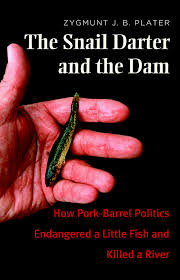 Saving an endangered species can be a blood, sweat and tears affair.
That reality is writ large in Zygmunt Plater’s excellent “The Snail Darter and the Dam: How Pork-Barrel Politics Endangered a Little Fish and Killed a River.”
The book is timely given the approaching 40th anniversary of the Endangered Species Act, which President Richard Nixon signed into law on Dec. 28, 1973.
Plater, a professor at Boston College Law School, crafts a compelling and entertaining narrative as he lays bare the mid-1970s fight over construction of the Tellico Dam on the Little Tennessee River.
The dam was a dubious Tennessee Valley Authority project that many saw as a regal example of pork-barrel politics. It would cost $28 million to build but would not generate any electricity. Instead it was planned as a development project. A new town called Timberlake would arise from the banks of the reservoir. The TVA claimed the project would create 25,000 jobs. The utility’s internal documents revealed a less rosy projection: the project would lose nearly 50 cents on the dollar.
At the outset it was a battle between a motley crew of farmers, fishermen, and history buffs and the TVA, the giant federal utility created as part of Franklin Roosevelt’s New Deal in 1933 to develop region’s economy.
Plater details how the battle was all but lostuntil a biologist discovered a native species, the snail darter,in the Little Tennessee. The finger-size fish would soon become the center of a fight that started when the U.S. Fish and Wildlife Service grudgingly listed it as endangered in 1975.
Plater writes the saga from his view then as a lawyer who petitioned for the listing and fought all the way to the Supreme Court to prevent the TVA from completing the Tellico Dam, which would wipe out the snail darter’s only known habitat.
Some of the most illuminating chapters describe Plater’s education about how the political process works. It isn’t pretty. Think politicians and lobbyist acting on every Machiavellian impulse, without the least concern for the public good.
The effort to stop the dam ends with a shocking defeat, when an 11th hour rider is inserted into an unrelated federal bill that allowed the TVA to proceed with the dam.
The bracing book is as much about the flaws in the political process on Capitol Hill as it is about the fervor of environmentalists. Plater's book is a bittersweet tale that should be required reading for anyone interested in how environmental legislation lives or dies in the real world.
Edward Ortiz is a reporter with The Sacramento Bee where he writes about the environment, agriculture and the arts. He has written for The Boston Globe, the Berkshire Eagle and was 2004 Metcalf Fellow in Environment Reporting at The Providence Journal.
____________________________________________________________________________
October 2013
The Great Animal Orchestra: Finding the Origins of Music in the World’s Wild Places
by Bernie Krause
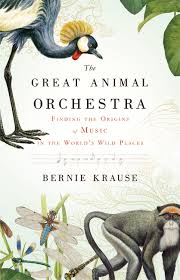
Animals have been howling, growling, hissing, squealing, chirping, trumpeting and otherwise vocalizing how our environment is doing from day one. But we haven’t been very good listeners.
So says Bernie Krause, a naturalist and musician who has recorded the sounds of 15,000 species worldwide. His recently published book, The Great Animal Orchestra, and accompanying sound tracks open our ears to an under appreciated dimension of the animal kingdom.
We’re certainly attuned to the big solo acts; there’s no missing a lion’s roar or the piercing bugle of a bull elk in heat. We’re all ears to choruses of frogs and wolves. But Krause says we’re mostly tone-deaf to the orchestral performances of natural communities as a whole. As a result, we’re missing great entertainment and, more importantly, sonic cues about the health of habitats.
Krause’s own ears were once bent on distinctly unnatural sounds. As a musician in the 1960s, he helped introduce the synthesizer to Hollywood pop music and film.
His acoustic sensibilities transformed during his first recording of wild sounds, in 1968 for an ecology-themed album. His mics and earphones brought sounds of birds in Muir Woods within a startlingly intimate range. Krause recalls feeling as though he had been “sucked into a new space.”
From there, Krause walks us through adventures and discoveries during his 30 year career as “soundscape artist,” capturing animal voices around the world for museum exhibits, films and other media. His sounds archive includes the obscene grunting of sea anemones, snapping shrimp and the even the sound of corn growing. (It squeaks as it rises telescopically.)
He describes an epiphany one night in 1983 on Kenya’s Masai Mara game reserve. His powerful stereo mics were picking up “a highly orchestrated acoustic arrangement of insects, spotted hyenas, eagle-owls, African wood-owls, elephants, tree hyrax, distant lions and several knots of tree frogs and toads.”
Before then, he said, the chatter of creatures “had all sounded like anarchy to my ears.” But on the Mara that night, patterns suggesting a musical structure “became too obvious to dismiss.”
Krause makes a plausible argument that our own music originated from the collective natural sounds. His more intriguing hypothesis – based on a mix of science and speculation – is that animal voices evolved so that each could be heard in the fray: “Each resident species acquires its own preferred sonic bandwidth — to blend or contrast — much in the way that violins, woodwinds, trumpets and percussion instruments stake out acoustic territory in an orchestral arrangement.”
Further, Krause asserts, if the habitat becomes significantly disrupted or spoiled, this orchestra-like structure unravels. Some creatures go silent – their homes destroyed - while others get out of sync or completely lose their distinct acoustic turf.
He’s found such changes over the decades in Amazon rain forests and in his home state of California. Near the Sierra’s Yuba Pass, he recorded the before and after of “selective” logging in a meadow and found the “sonorous” voices birds, insects and amphibians had vanished.
That was in 1988. He has revisited the site, Lincoln Meadow, 15 times in the past 25 years and found that while physical landscape has mostly recovered, the “bioacoustic vitality” he captured before logging had not yet returned.You can hear and even see and the acoustic difference here.
Toward the end of the book, Krause detours into preachy laments about Americans tuning out nature with their snowmobiles, jet skis and dune buggies. But overall you’ll find The Great Animal Orchestra an intriguing and refreshingly different take on our environment. It will inspire you to experience nature with your ears.
____________________________________________________________________________
SEPTEMBER 2013
The Genius of Earth Day: How a 1970 Teach-In Unexpectedly Made the First Green Generation
by Adam Rome
By guest reviewer Jim Wasserman
 As a high school senior I kept a small red diary from Woolworth’s that opens to April 22, 1970, with the words, “Earth Day. We had a whole-day ‘teach in’ about problems of pollution. It was good to learn about the various aspects of it.”
Today, Earth Day is an established part of the American calendar, a good-spirited occasion to clean up creeks, spruce up parks, plant trees and teach a lesson on climate change.
In “The Genius of Earth Day,” author Adam Rome provides a delightful account of the origins of this iconic eco-awareness day and how it has endured. “I’ve come to believe that the first Earth Day is the most famous little-known event in modern American history,” Rome tells us, arguing that the story of April 22, 1970, “ultimately, is about the making of the first green generation.”
Rome memorably recaptures the blooming environmental anxiety of the 1960s and 1970s, and the intellectual ferment stirred by such books as “Silent Spring” and “The Population Bomb.” He introduces us to the founding Earth Day personalities, the late U.S. Senator Gaylord Nelson of Wisconsin, who announced the concept on November 11, 1969, and the event’s Stanford-educated national coordinator Denis Hayes, now president and chief executive officer of the Seattle-based Bullitt Foundation.
Few remember today that Earth Day originally was to be called “Environmental Teach-in.” The more likeable “Earth Day” came from New York “advertising guru” Julian Koenig, renowned for the Timex ad jingle, “It takes a licking and keeps on ticking.” The new name debuted Jan. 18, 1970, in a full-page ad in The New York Times, becoming arguably the best-known brand in modern environmentalism.
The strength of Rome’s book is the much larger cast of grassroots organizers who planned and conducted an estimated 12,000 to 13,000 teach-ins, rallies, roundtable discussions and workshops attended by millions. We meet high school students, college idealists, university professors and mothers concerned for their children’s future.
Rome revisits Earth Day events in New York (where 250,000 people picnicked and reveled on a long stretch of Fifth Avenue closed to traffic), Miami, Birmingham, Cleveland, Penn State and California’s Central Valley (scene of a “survival walk” from Sacramento to LA). The book also spotlights Earth Day tensions, mostly forgotten now, among civil rights and anti-war activists who resented the potential diversion of energy from their own vital causes. Vietnam protestors favored demonstrations and dramatic gestures (burying car engines was a favorite) while engineering and science majors preferred technical discussions and often invited corporate representatives.
Perhaps the most striking thing about “The Genius of Earth Day” is its recollection of the polluted mess the United States had become by 1970. In California, smog defined Los Angeles in the manner of today’s Beijing. The Santa Barbara oil spill of January and February 1969 remained a fresh memory. Unlike today’s worries over climate change, hormone-disrupting chemicals and biodiversity loss, the environmental assaults that gave rise to Earth Day arose were dramatically visible and powerfully symbolized: the soot-black exhaust from smokestacks and tailpipes, the bulldozer ripping up the countryside and, in my home state of Ohio, the oil-coated Cuyahoga River that caught fire 10 months before Earth Day.
“The Genius of Earth Day” memorably brings back to life a single day in the United States that has shown an enduring power to change the world. Those of a certain age who were there and participated on April 22, 1970, will take special delight in this recalling of a foundational and idealistic experience.
Rome opens the book saying, “Historians have assumed that the force of Earth Day 1970 was essentially symbolic.” By the end, he has provided a convincing case to the contrary, and a story for all generations, with his powerful documentation of a lasting ethic and the vast environmental progress that made Earth Day so much more.
Jim Wasserman is a project manager for the Commission on California State Government Organization and Economy (The Little Hoover Commission), where he is managing a study on climate change adaptation. Previously, he was an information officer with the California Department of Toxic Substances Control and a reporter with The Sacramento Bee and The Associated Press.
____________________________________________________________________________
AUGUST 2013
On a Farther Shore: The Life and Legacy of Rachel Carson
by William Souder
 You don't have to be especially interested in Rachel Carson to appreciate William Souder’s recent biography of the visionary environmentalist.
On a Farther Shore also shines insightful light on science writing and the history of American environmentalism.
To recap, Carson is credited with putting the modern environmental movement into motion with the publication of her 1962 bombshell, Silent Spring. Her signature book is both a science story on the environmental fate of pesticides and a powerful indictment of their unbridled use.
Following World War II, new classes of long-lived bug and weed killers developed for military use were loosed on American society with few restraints on potency or application. The chemical industry and federal government dispersed the poisons widely with an appalling ignorance – or denial – of their potential harm to humans and other non-targeted species.
DDT was the biggest gun in the chemical arsenal. Considered a panacea to insect-borne disease and crop damage, the Agriculture Department conducted massive aerial sprayings to wipe out fire ants and other pests. Manufacturers infused DDT in household paint, shelf paper and even soap. Hospitals sprayed their kitchens. Public health officials dispatched tanker trucks to fumigated beaches and parks as children frolicked in the murk.
The chemical recklessness was bound to incite a public backlash as evidence of collateral damage mounted: dead fish, deformed frogs and diminishing populations of birds and other wildlife. What was it about Carson and her polemic that lit the fuse?
Souder explains. First, he dispels notions of Carson being an environmental extremist out to demonize the chemical industry and ban all synthetic pesticides – myths that persist to this day, much as the residues of long-banned DDT. Carson actually acknowledged the public health merits of pesticides, though she advocated for more sustainable natural pest controls.
Drawing from a wealth of public and private sources – from intimate love letters to school yearbook signings – Souder casts Carson as an apolitical and unsociable bookworm infatuated with marine ecology, to the exclusion of nearly everything else.
And yet at 55 years old, while battling terminal breast cancer, Carson blew the lid off the pesticide industry’s new wonder products – “elixirs of death” she called them.
What turned this popular writer of starfish and eels into such a fierce polemicist? Souder shows she was driven by outrage over the “towering arrogance” of humankind reversing the laws of nature. “She had always believed that the environment molded life, not the other way around.” The proliferation of persistent, genetically altering synthetic pesticides had unnaturally altered the environment, making humans biologically defenseless.
The public, though, knew nothing about the insidious nature of these chemical compounds – how they bioaccumulate up the food chain, store in human body fat and enter unborn babies through the placenta.
The genius of Silent Spring was in framing the fallout from these compounds more broadly with something many people familiar with and worried about then at the height of the Cold War: the fallout from nuclear radiation. Carson drew parallels between pesticides and radiation throughout the book. That’s what made Silent Spring resonate from home kitchens to the Oval Office.
For all her literary heft and honors, we learn from this biography that Carson was a painfully slow but proud writer who constantly revised and tested the patience of her editors and book agents.
Souder also explores with grace and sensitivity Carson’s long romantic friendship with a married woman, concluding from their surviving correspondence that the relationship “existed in a realm above the ordinary physical love and desires.”
Readers mainly interested in Carson may be annoyed by the extensive historical context that doesn’t so much weave through the book at branch into protracted detours. The interludes are interesting, but 40 pages on the nuclear arms race without mention of Carson?
Overall, On a Farther Shore is an engaging biography that helps us understand how and why American environmentalism shifted so abruptly in the early 1960’s from optimistic conservation to the divisive movement we know today – a movement Rachel Carson catalyzed but never lived to see.
Next month Chris Bowman reviews The Great Animal Orchestra by Bernie Krause, on the new field of ‘soundscape ecology’ – relating voices of the natural world to ecosystem health.
____________________________________________________________________________
JUNE 2013
The Mountain and the Fathers: Growing up on the Big Dry
by Joe Wilkins
 My father promised me a shotgun for my 12th birthday, which was not at all unusual for a Montana kid. Certainly not back in 1966. That was the year my Dad and I logged the most flight time together in the Cessnas he sold for a living.
We’d swoop low at the sight of antelope for a fun chase across the mesas. I was itching to bag a pronghorn – anything with antlers, actually. I wanted to mount a pair on the knotty pine walls of my bedroom. There I would hang our bamboo fly-fishing rods, canvass creels and the fluorescent pink caps we wore in the field so hunters wouldn’t mistake us for game.
The Mountains and the Fathers rekindled sweet memories of my own father and I. The new book is a memoir by Joe Wilkins, a gifted writer 24 years my junior who grew up 85 miles north of my childhood home in Billings. This is the Big Dry, a drought-punished country in the vast plains of east central Montana.
Wilkins nails the sense of this place dead-on with poet’s eyes that see the landscape as “one part grass and two parts sky” and musician’s ears for the “grass that cracks beneath your steps.” The snap shirts, feed store ball caps, Rainier beer cans, antelope breakfast steaks, Chinook winds and the opaque plastic sheets covering windows in the winter evoked the romance of the interior West that I cherished as a boy.
However, unlike my short-lived Big Sky adventure (We moved to the Bay Area just as I turned 12, ruling out the shotgun), Wilkins’ nostalgia for the Big Dry is bittersweet. Writing in his early 30s, Wilkins reflects on his youth as a story of survival. His father died when he was 9, leaving his mother to raise him and two siblings on a 300-acre sheep and hay farm in a gritty dot of a community called Melstone. They survived on the whims of rainfall and a coal-fired furnace in a drafty house “cobbled together from the ruins of homesteader shacks.”
“You couldn’t call it a living. It was a kind of ritualized dying,” Wilkins writes.
More than a memoir, the book is an indictment of the ideology of rugged individualism so deeply rooted in the arid American West. The success-through-hard-work religion no doubt makes for rugged individuals. However, this book shows that it also turns individuals against their land and, ultimately, themselves.
Wilkins’ portrays a dismal array of childhood peers, including an overgrown bully named Rooster. Several are abandoned or abused by their parents or relatives. By his mid-teens, Wilkins joins his lot in drinking hard, driving fast and doping on nicotine. But he stops short of throwing punches and smoking marijuana. He has boundaries because he has hope.
That hope springs from his rancher grandfather who gifts him a vision for some better life beyond Melstone and from the stories told of his esteemed father whom Wilkins has subconsciously erased from memory. The author was also blessed with imagination, thanks to his college-educated mother, Olive, who gifts him a love for reading.
This book brings to mind novelist Wallace Stegner’s stories of those like his father who fell victim to the rain-follows-the-plow myth. (The Big Rock Candy Mountain and Where the Bluebird Sings to the Lemonade Springs.)
The Mountains and the Fathers is another poignant lesson in reconciling ourselves with our natural environment. Working the land in the Big Dry yields riches, but they are marginal and ephemeral.
Blaming failure not on the elements but on the character of the participants is a recipe for self-destruction. Working the land harder through overgrazing and other brute force only brings impoverishment to the land and its people.
“We need to remember how it really was and is out West, and we need to tell those true new stories,” Wilkins writes.
The Mountains and the Fathers is one of “true new stories,” well told.
____________________________________________________________________________
MAY 2013
Toms River: A Story of Science and Salvation
by Dan Fagin
 When victims of the same rare cancer live in the same neighborhood, it’s tantalizing to think an environmental villain is at play. But it’s fantasy to believe one will be found, let alone convicted.
That’s one of the many lessons from the childhood cancer cluster that haunted the New Jersey town of Toms River, the subject of a new book by journalist Dan Fagin.
Despite enormous costs and efforts, health investigators have never determined the cause in any of the hundreds of residential cancer clusters examined in the United States since 1960. They haven’t even identified likely culprits, but for two highly publicized exceptions. The Toms River cluster is one of them.
At least 69 children in the seaside community developed leukemia or brain tumors in the late 1970s through 1990s. Some died. Health investigators, egged on by parent activists, eventually determined that most of the victims lived in the parts of town that were most exposed to the toxic wastes – via drinking water and polluted air – of two large chemical plants.
In the other exceptional case, investigators linked a 1970s outbreak of childhood leukemia in Woburn, Mass., to industrial contaminants in the city water supply. The liability lawsuit brought by victims’ families against Beatrice Foods and W.R. Grace inspired the acclaimed book-turned-movie thriller, A Civil Action.
Toms River is not written in a made-for-the-movies way. Rather, it’s a blend of equal parts narrative and context. Rich primers on the history and science of environmental health investigations are woven throughout the story at all the right places, like well-placed streetlamps.
Fagin’s exploration is as enlightening as it gets in the murky world of cancer clusters. It’s also courageous. Few journalists dare to drill deep into suspect clusters for much the same reasons health authorities are loath to investigate them. They are fraught with ambiguity, highly nuanced, extremely time-consuming and always inconclusive.
Fagin explains why, in the cold eyes of science, the perceived "cluster" almost always dissolves into statistical insignificance. But, impressively, he also shows the limits of that science.
To analyze disease patterns, health scientists rely on tumor registries that track cancer diagnoses and deaths statewide. But the method is not scientifically valid at the community level. The population of Toms River – roughly 90,000 in 2000 – is too small for scientists to tell whether a higher-than-expected incidence of like cancers is a fluke or a real “cluster” – one unlikely due to chance – meriting on-site investigation. But that didn’t stop New Jersey officials from telling Toms River residents their cancer rates were not unusual – no worries.
“A clever political solution – and a scientifically illegitimate one,” says Fagin, a veteran investigative reporter who teaches science and environmental reporting at New York University.
Though science-oriented, Fagin’s account sharply illustrates the power of grassroots activism and the importance of the bedrock federal pollution-controls laws enacted in the 1970s.
Activist parents working their social connections drove the cluster investigation more than science and evidence. The drama culminated in 2001 when some of the families of cancer victims won a multimillion-dollar settlement against Ciba-Geigy (formerly Toms River Chemical Co.) and Union Carbide and the local water utility.
For 25 years, the fast-growing chemical manufacturers profited by using the town’s namesake river as a sewer and secretly burying their toxic wastes in the sandy soil – eventually contaminating municipal wells. State pollution enforcers knew, but said and did nothing. The local water utility knew, but took no action and left its customers in the dark.
Ciba-Geigy didn’t build a modern lined landfill or treatment plants until the new U.S. Environmental Protection Agency came to town. The EPA also blew the lid off of the drinking water contaminants.
Toms River is scholarly, but it is not an academic tome. For all the science and government agencies the author navigates, the writing is blessedly fluid, unassuming and unblemished by acronyms. And Fagin’s investigative what-did-they-know-and-when-did-they-know-it approach gives the industrial poisoning of Toms River its due in public outrage and corporate disgrace.
____________________________________________________________________________
APRIL 2013
After the Grizzly: Endangered Species and the Politics of Place in California
by Peter Alagona
Reviewed by guest reviewer, Edward Ortiz
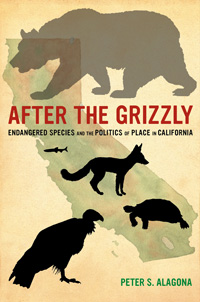 It's pure irony that California, long considered a leader in conservation and wildlife management, has a grizzly bear as the main symbol on its state flag.
On the eve of statehood California had roughly one grizzly for every 12 people. Today there are none in the wild, with the last such bear sighted in 1925.
In the authoritative book After the Grizzly: Endangered Species and the Politics of Place in California, author Peter Alagona sees the bear as a cautionary symbol.
It's one that Alagona contends set California on a path to becoming a political hotbed for endangered species protections. Today the state hosts the largest diversity of plant and animal species in the nation, and the largest number of endangered species (more than 300) than any other state outside of Hawaii.
Alagona weaves a chronological tale around the grizzly and four imperiled species - the California condor, the Mojave Desert tortoise, the San Joaquin kit fox and the now-infamous delta smelt.
Each species was, or is still, at the center of an endangered species effort or battle. And each battle led to the formation or further evolution of an environmental ethic or policy.
For the California condor, the threat was habitat degradation. For the desert tortoise, land use was the issue, with the federal Bureau of Land Management, in 1976, creating a 25,000-acre Desert Tortoise Natural Area for its protection in the Mojave Desert.
After the Grizzly explains how California became a national leader in species conservation and protection. The story begins in the early 20th century at UC Berkeley, where a circle of committed scientists led by a young zoologist named Joseph Grinnell promoted conservation ethics in wildlife management.
The book sometimes reads like an environmental history textbook. Nonetheless, Alagona takes care to tell a compelling story of each endangered species, what threatens its habitat and how humans changed their advocacy to protect it.
Alagona asserts that each of the species has served as a proxy to argue for larger societal issues. In short, the book is more about the human animal as it is about endangered species.
Edward Ortiz is a reporter with The Sacramento Bee where he writes about the environment, agriculture and the arts. He has written for The Boston Globe, the Berkshire Eagle and was 2004 Metcalf Fellow in Environment Reporting at The Providence Journal.
Next month Chris Bowman reviews Toms River: A Story of Science and Salvation by Dan Fagin, an exposé of childhood cancer cases in the industrial town of Toms River, New Jersey.
____________________________________________________________________________
For more Bowman on Books reviews, click here.